


AMD: What Conventional Medicine Offers — and Where It Ends
Age-related macular degeneration (AMD) is the leading cause of severe central vision loss in adults over 50 in the developed world, and the clinical options are more limited than most patients expect. For wet AMD — the less common but faster-progressing form driven by abnormal new blood vessel growth under the macula — anti-VEGF injections (ranibizumab, aflibercept, bevacizumab) have transformed outcomes. They slow the vascular assault. They do not restore the vision already lost.
For dry AMD — the slow, atrophying form that accounts for roughly 80% of all AMD — the honest clinical answer is more sobering. High-dose AREDS2 supplementation may slow progression in intermediate-to-advanced cases. Beyond that, ophthalmology offers monitoring and management. It does not yet offer a means of halting the retinal pigment epithelium atrophy that characterizes the condition.
This is where patients find their way to Makari Wellness. Not to be promised a different outcome, but to address the constitutional terrain — the Liver-Kidney axis, the Blood and Essence substrates — that classical Chinese medicine has long recognized as the systemic root of macular vulnerability.
The TCM Picture: Liver, Kidney, and the Macula
In the classical eye framework, the Water Wheel (Shuǐ Lún, 水輪) — the pupil — maps to the Kidney, and the Wind Wheel (Fēng Lún, 風輪) — the iris and retina — maps to the Liver. Using Dr. Dzung’s Five Regions lens, the same mapping holds: Pupil reflects Kidney, Iris reflects Liver. The macula sits squarely in the territory where Kidney Essence (Jīng, 精) and Liver Blood converge to nourish the eye’s most delicate, metabolically demanding tissue.
Two primary patterns govern AMD in clinical practice:
Pattern 1 — Liver-Kidney Yin deficiency (Gān Shèn Yīn Xū, 肝腎陰虛): This is the dry AMD picture. The progressive atrophy of the retinal pigment epithelium reflects a deepening depletion of the Yin-substance and Essence that the Liver and Kidney together supply to the eye. The presentation is slow, structural, and age-driven. Patients report gradual central blur, distortion, loss of fine-detail vision. The tongue is typically pale or dry-red with a thin coat; the pulse is thin and weak in the Liver and Kidney positions.
Pattern 2 — Liver-Kidney Yin deficiency with Blood stasis (Xuè Yū, 血瘀): This is the wet AMD picture. The Yin deficiency creates a desiccated terrain in which Blood, unable to flow freely, forms stasis patterns in the retinal collaterals. Pathological neovascularization — the new, fragile vessels that bleed under the macula — reflects what classical texts describe as “wayward Blood” (Lí Jīng Zhī Xuè, 離經之血): Blood that has left its proper channels. Sudden or rapid central vision change, metamorphopsia, and subretinal fluid are the clinical hallmarks.
Acupuncture for Macular Degeneration: The M48 Protocol
In the MA48 (Micro Acupuncture 48) system, AMD falls into the Drying category for the dry form and the Bleeding category for wet AMD. Both call for distal point selection from Makari’s specialized 48-point hand and foot microsystem — no needles are placed near the eye itself.
The standard protocol for AMD builds around four core points, selected and modified based on palpatory findings at each visit:
- LR-A (Liver-A, distal Yang point): The primary functional point for all eye conditions. The Liver governs the eyes in classical theory, and LR-A accesses that functional-sensory dimension directly. Almost always included.
- LR-B (Liver-B, proximal Yin point): The structural-constitutional counterpart to LR-A. Added when the Liver Yin deficiency root is prominent — the slow-atrophy dry AMD picture is precisely the indication.
- KI-B (Kidney-B, proximal Yin point): Accesses the deep Kidney Essence substrate. For any condition where the Water Wheel (pupil/macula) is compromised and the constitutional Jing depletion is the root, KI-B is the foundational point.
- GB-A (Gallbladder-A, distal Yang point): Supports optic circulation and lateral visual field; the Gallbladder channel runs through the lateral eye orbit and temporal region. Particularly useful for cases where microcirculatory compromise accompanies the atrophy.
The practitioner palpates all candidate points before needling; hot or tender points in the treatment zone are prioritized for selection. Needles are 34-gauge half-inch, inserted at approximately 45° onto the periosteum, with 30-minute retention. Response to M48 for AMD typically requires a committed course of care — four to twelve sessions — and realistic expectations. About 15% of patients do not respond.
Scalp Acupuncture: Vision Three Needles + Electro
Every AMD session at Makari includes scalp acupuncture targeting the Occipital Vision Area (枕上視覺區) — the cortical visual cortex representation on the posterior scalp, following the Dr. Karl Tai lineage. The standard set is Vision Three Needles (Shì Sān Zhēn, 視三針): three scalp needles placed in the occipital Vision Area in a triangular arrangement.
Electro-stimulation is mandatory. We apply Dense-Disperse wave — the “Pulling Qi Method” (Chōu Qì Fǎ, 抽气法) — to the Vision Area needles at 1–4 Hz for the chronic degenerative AMD picture (sustained parasympathetic/tissue-remodeling register). The galvanic current drives enhanced retinal blood flow and optic-nerve conduction. Many patients report a subjective “immediate brightening” during the scalp treatment. This sensory shift does not constitute a treatment outcome; it signals neural engagement with the circuit.
Periorbital adjuncts BL-2 (Cuánzhú, 攢竹) and SJ-23 (Sīzhúkōng, 絲竹空) are added at the practitioner’s discretion to support the local circulatory picture.
Chinese Herbs for AMD
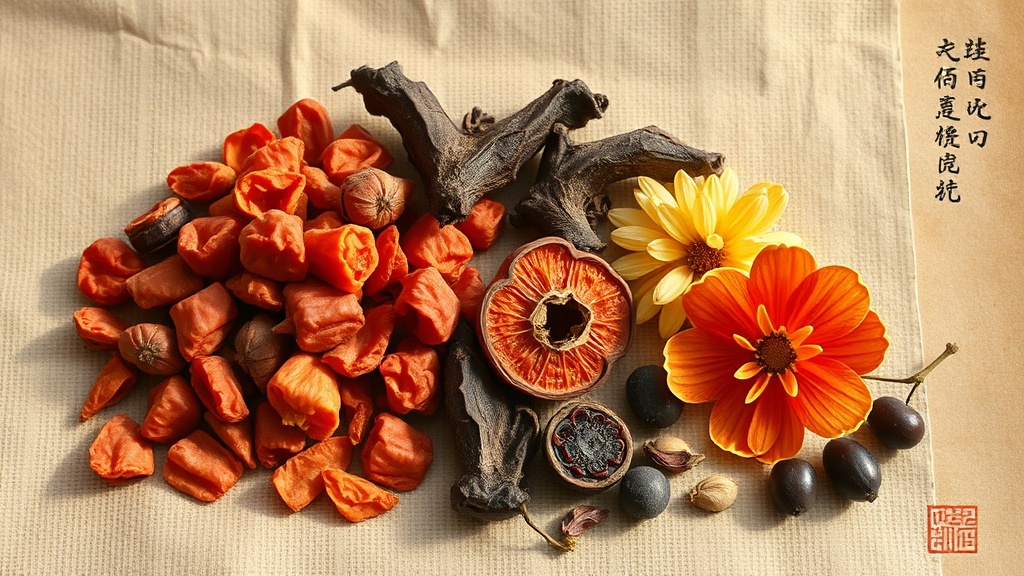
The classical herbal approach to AMD addresses the Liver-Kidney Yin-deficiency root with a formula built around three key herbs — framed here as illustrative examples of the nourishing category:
- Gou Qi Zi (Gǒu Qǐ Zǐ, 枸杞子) — wolfberry: The classical “brightens the eyes” herb, nourishing Liver and Kidney Yin and Blood. Modern analysis identifies Gou Qi Zi as the richest dietary source of zeaxanthin — the primary macular carotenoid pigment. This is not coincidence; classical materia medica practice mapped the herb’s clinical action centuries before the biochemistry was understood.
- Nu Zhen Zi (Nǚ Zhēn Zǐ, 女贞子) — ligustrum berry: Nourishes Liver and Kidney Yin; modern research points to its anthocyanin content and neuroprotective activity on retinal ganglion cells.
- Ju Hua (Jú Huā, 菊花) — chrysanthemum flower: The classical “eye herb” in Chinese medicine — clears Liver and brightens eyes; gently addresses the visual-field turbidity that accompanies Liver Yin deficiency.
For wet AMD with Blood stasis, the formula adds Blood-moving herbs such as Dan Shen (Dān Shēn, 丹参, salvia root) to address the neovascular stasis pattern. Formula design is always individualized from the intake; the above are orienting examples, not a prescription.
Functional Medicine Integration
Functional medicine supplements are named and deployed freely in clinical care at Makari. For AMD, the relevant categories and specific agents include:
- Carotenoid antioxidant class: Lutein and zeaxanthin (the two macular pigments, supporting optical density and blue-light filtration); astaxanthin (a potent carotenoid antioxidant with documented retinal penetration and anti-inflammatory action at the retinal pigment epithelium).
- Microcirculation class: Bilberry (European blueberry extract; anthocyanins support capillary integrity and retinal microvascular function); ginkgo biloba (supports optic nerve blood flow through PAF-inhibition and microvascular dilation); omega-3 fatty acids (EPA/DHA; structural components of photoreceptor membranes and anti-inflammatory regulators in the retinal environment).
- Neuro-optic mitochondrial support class: Acetyl-L-carnitine (ALCAR; mitochondrial function in retinal ganglion cells; studied in a European trial for AMD and shown to have modest but real effects on visual field parameters).
The FM protocol is always derived from the pattern diagnosis, not applied as a generic “eye supplement stack.” Which sphere is most compromised — antioxidant, microvascular, or mitochondrial — guides the selection.
An Honest Word About What This Offers
No herbal medicine reverses AMD. No acupuncture protocol restores the retinal pigment epithelium that has already atrophied. The classical framework aims to support the Jing-Blood terrain that nourishes remaining retinal tissue, address the stasis patterns that may accelerate wet progression, and provide the body’s own repair mechanisms with the constitutional substrate they need to function. That is meaningful clinical work. It is not a promise of recovery.
A 2026 systematic review in Frontiers in Medicine by Bautista-Hernández MA and colleagues confirmed that current evidence for acupuncture in AMD and related conditions is insufficient to make definitive claims — heterogeneous studies, small samples, varied methodology. We cite this not to undermine the work, but because patients who find us deserve that honesty. The integrative research field for eye disease is alive and growing. We operate within it carefully. Frontiers in Medicine, 2026.
Curious? Let’s Talk.
If you or someone you love is navigating age-related macular degeneration and wondering what integrative acupuncture and herbal support might look like, we’d love to have that conversation.
The M48 protocol isn’t a promise — it’s a conversation. One grounded in classical theory, clinical experience, and an honest engagement with the evolving science.
Makari Wellness — Michael Woodworth, M.S., L.Ac. (established 2005)
Specializing in degenerative eye disease via the M48 protocol
Call us: (888) 871-8889
Book online: makariwellness.com/book-appointment
Oceanside: 2111 S. El Camino Real, Suite 301, Oceanside, CA 92054
San Diego: 16486 Bernardo Center Drive, Suite 218, San Diego, CA 92128
This content is educational and does not constitute medical advice. Acupuncture and herbal medicine are not replacements for conventional ophthalmologic care. Always continue your care with your ophthalmologist.