


Central Serous Retinopathy: When Stress Pools Fluid at the Macula
A recognizable patient: one eye blurred as though “looking through water,” appearing during a high-stress period or after corticosteroid use. Ophthalmologic imaging confirms central serous chorioretinopathy (CSC or CSCR) — fluid accumulating beneath the neurosensory retina at the macula. Objects look smaller (micropsia), colors wash out, and fine detail sits behind a watery haze. In classical Chinese ophthalmology this is called 視瞻有色 (shì zhān yǒu sè, “tinted or coloured vision”) — two medical traditions, millennia apart, describing the same event: fluid at the macular center under systemic strain.
What Happens in CSR
The retinal pigment epithelium (RPE) pumps fluid from the subretinal space into the choroid below. When that pump fails — through RPE dysfunction or choroidal hyperpermeability — fluid pools beneath the photoreceptors and distorts the macula. The CSR demographic is specific: young-to-middle-aged men (20–50s), Type A personality profiles, high-stress occupations. Corticosteroid exposure of any route — or the endogenous cortisol load of chronic stress — is the dominant risk factor; cortisol directly promotes choroidal hyperpermeability. Acute CSR often resolves spontaneously within 3–4 months, but chronicity risks progressive RPE atrophy and permanent central vision loss — which is why the constitutional terrain producing each episode matters alongside the acute monitoring.
Three TCM Patterns
Spleen Qi Deficiency with Damp Accumulation (Pí Qì Xū, Shī Yè Nì Yǎn, 脾气虚,湿液逆眼)
The core pathomechanism of CSR in classical Chinese ophthalmology. The macula corresponds to the Earth element and the Spleen’s (Pí, 脾) function of transforming and transporting fluids. When Spleen transport fails, dampness (Shī, 湿) accumulates rather than being distributed — reversing into the subretinal space at the macular center, the Chinese medicine parallel to RPE pump failure. Confirming signs: easy fatigue, digestive irregularity, heaviness in the body, pale or subtly swollen tongue with white coating.
Liver Qi Constraint Overacting on Spleen (Gān Qì Yù Jié, Gān Mù Chéng Tǔ, 肝气郁结,肝木乘土)
CSR is the archetypal Liver-overacting-on-Spleen condition in Chinese ophthalmology. The Wood element — Liver (Gān, 肝) — must flow freely for Spleen-Earth to function without interference. When stress or a sustained cortisol load creates Liver Qi stagnation, the Liver over-controls the Spleen and collapses its fluid transport function. The Type A, high-stress CSR demographic maps precisely onto the classical Liver Qi constraint portrait.
Liver-Kidney Deficiency (Gān Shèn Kuī Xū, 肝肾亏虚) — The Chronic Root
When episodes recur over years, Liver-Kidney Essence (Jīng, 精) depletion sustains RPE dysfunction between flares; the Kidney (Shèn, 肾) can no longer anchor and nourish the Liver. Systemic depletion markers — tinnitus, low-back aching, fatigue that does not recover with rest — accompany the recurring ocular pattern. Treatment must nourish the deep root before dampness-resolution strategies can hold.
Acupuncture: The M48 Protocol
Micro Acupuncture 48 (MA48), developed by Andy Rosenfarb, ND, LAc, maps 48 holographic points across the hands and feet through the ECIWO principle — no needles near the eye. CSR draws from the Pressure classification family.
- SP-A — primary Spleen-damp point; foundational for macular fluid accumulation
- LR-A — smooths Liver Qi constraint; reduces the Wood-over-Earth pressure dynamic in the stress-driven pattern
- ST-A — grounds the Earth axis; the paired Stomach point stabilizes the Spleen intervention
- GB-A — opens the Wood-Yang surface alongside LR-A; full Liver/Gallbladder axis in Qi stagnation
- SJ-A — the San Jiao (Sān Jiāo, 三焦) governs the HPA-axis cortisol response in functional terms; directly addresses the cortisol-choroidal permeability connection
- HT-A — the Heart (Xīn, 心) axis; addresses shen-disturbance sustaining cortisol dysregulation; for recurrent CSR with Kidney depletion, KI-B addresses the Essence-deficiency root
Scalp Acupuncture and Electroacupuncture
The scalp component uses Vision Three Needles (Shì Sān Zhēn, 視三針) in the Occipital Vision Area (Zhěn Shàng Shì Jué Qū, 枕上視覺區) to support central visual processing during the acute distortion phase. Electroacupuncture at 1–4 Hz Dense-Disperse wave applies the parasympathetic, fluid-regulating protocol — counteracting the cortisol-driven sympathetic dominance behind choroidal hyperpermeability. Body-point anchors: GB-20 (Feng Chi, 風池) to descend Liver Yang; CV-12 (Zhong Wan, 中脘) to harmonize the Middle Burner fluid axis; SP-9 (Yin Ling Quan, 陰陵泉) and SP-6 (San Yin Jiao, 三陰交) to drain Spleen dampness through the lower path.
Chinese Herbal Medicine
Three herbs illustrate the primary therapeutic categories in the Spleen-damp / Liver-constraint formula:
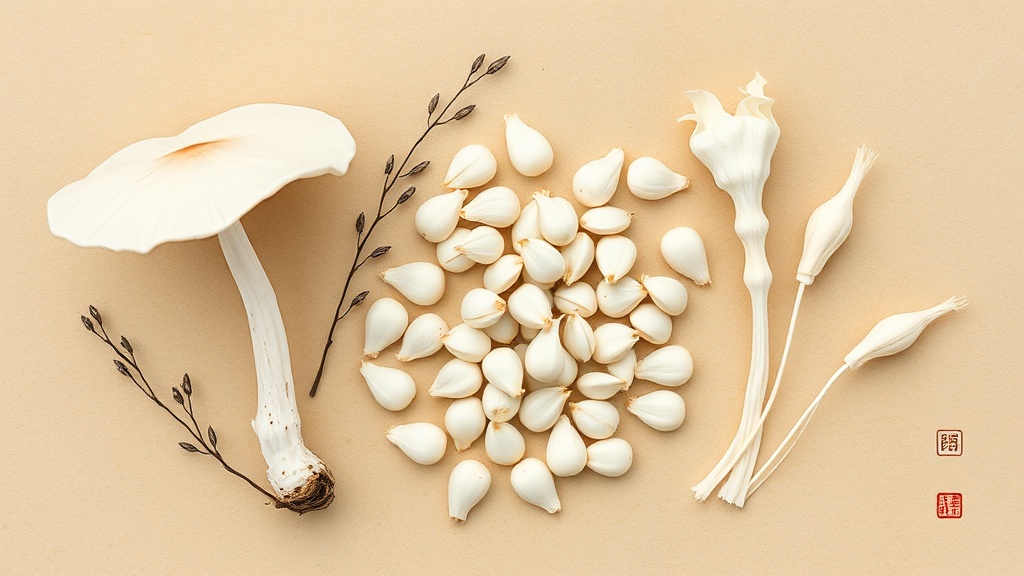
- Fu Ling (Fú Líng, 茯苓) — poria mushroom; the chief Spleen-tonifying, dampness-draining herb; calms the mind alongside its dampness-resolving action; foundational to any formula for macular fluid accumulation
- Bai Zhu (Bái Zhú, 白术) — white atractylodes; fortifies Spleen Qi and dries dampness; the Fu Ling–Bai Zhu pair is the Spleen-transport restoration duo that addresses the transport failure at the macular center
- Chai Hu (Chái Hú, 柴胡) — bupleurum; primary herb for smoothing Liver Qi constraint; in the Xiao Yao San framing it lifts the Wood pressure and allows Spleen transport to recover
Functional Medicine — The Cortisol-Choroid Axis
CSR may be the most directly cortisol-mediated condition in retinal medicine. Cortisol promotes choroidal vascular hyperpermeability through mineralocorticoid receptor activity in the RPE — the mechanism that makes both exogenous steroid use and chronic psychological stress converge as the dominant risk factor. Key supplements in the integrative CSR approach: Phosphatidylserine (PS) to blunt the cortisol stress response through ACTH modulation; Astaxanthin for RPE mitochondrial antioxidant support and choroidal vascular integrity; Bilberry to reduce choroidal hyperpermeability through anthocyanoside-mediated capillary tone; Adaptogens (ashwagandha / rhodiola) for HPA axis normalization in the chronic-recurrent picture; CBD oil for endocannabinoid modulation of choroidal tone and cortisol dysregulation at the RPE (Rosenfarb integrative CSC protocol); and Magnesium glycinate for HPA axis and mineralocorticoid buffering.
What the Research Shows
A 2026 systematic review in Frontiers in Medicine by Bautista-Hernández MA and colleagues examined acupuncture evidence for macular and retinal conditions. Honest conclusion: current evidence is insufficient for definitive claims — studies are heterogeneous, sample sizes small, methodology varied. This is a call for better-designed integrative research, not a verdict against the approach. Frontiers in Medicine, 2026. We work within that uncertainty transparently.
Safety and Monitoring: What CSR Requires
- Corticosteroid review is co-management priority one. Any exogenous corticosteroid in current use — inhaled, nasal, topical, oral, or intra-articular — should be reviewed with the prescribing physician for feasibility of reduction or elimination. We flag this; we do not modify medications unilaterally.
- Monthly OCT monitoring is the standard of care during active CSR. We reinforce this schedule without exception.
- Acute CSR often resolves spontaneously. For a first episode with fluid present less than 4 months, watchful waiting is appropriate. Our integrative work runs alongside that conservative window.
- If fluid persists beyond 4 months, referral to a retina specialist for laser photocoagulation or photodynamic therapy (PDT) is indicated. RPE atrophy is the risk of unresolved chronic CSR — we make this referral conversation clearly.
Curious? Let’s Talk.
If you or someone you love is experiencing the “looking through water” blur of central serous retinopathy — especially if stress, corticosteroid use, or a high-pressure lifestyle seems woven into the picture — we’d love to have that conversation.
The M48 protocol isn’t a promise — it’s a conversation. One grounded in classical theory, clinical experience, and an honest engagement with the evolving science.
Makari Wellness — Michael Woodworth, M.S., L.Ac. (established 2005)
Specializing in degenerative eye disease via the M48 protocol
Call us: (888) 871-8889
Book online: makariwellness.com/book-appointment
Oceanside: 2111 S. El Camino Real, Suite 301, Oceanside, CA 92054
San Diego: 16486 Bernardo Center Drive, Suite 218, San Diego, CA 92128
This content is educational and does not constitute medical advice. Acupuncture and herbal medicine are not replacements for conventional ophthalmologic care. Always continue your care with your ophthalmologist.