

Male Factor Infertility: The Side of the Story Chinese Medicine Addresses Well
Fertility Is a Team Sport — And the Male Half Gets Overlooked
When a couple struggles to conceive, the conversation almost always starts with the woman: hormone panels, cycle tracking, ovarian reserve testing. The male partner often gets a quick semen analysis and a thumbs-up — or a shrug — and that’s the end of it. But roughly 40–50% of all couple infertility involves a male factor. In nearly half of the couples sitting in waiting rooms, the sperm are part of the story. Chinese medicine has been thinking about this for a long time, and what it offers men specifically is both nuanced and clinically useful.
What Western Medicine Evaluates — and Where the Gaps Are
The standard entry point for male fertility assessment is the semen analysis. WHO 2021 reference parameters give us the clinical floor: morphology at 4% normal forms (Kruger strict), total motility at 40% with 32% progressive, concentration at 16 million sperm per milliliter. When numbers fall below these benchmarks — low count (oligozoospermia), poor motility (asthenozoospermia), abnormal morphology (teratozoospermia), or combinations — reproductive medicine has real tools: varicocele repair, IUI, IVF with ICSI, clomiphene, or HCG.
Where conventional workup can leave men without answers is when the semen analysis is borderline, or when structural causes have been ruled out and the underlying driver is more diffuse: oxidative stress, hormonal imbalance, lifestyle load, chronic inflammation. That’s exactly where Chinese medicine and integrative approaches have something specific to offer. The other critical fact: spermatogenesis takes approximately 72–90 days. Any intervention requires a minimum 3-month course before re-testing — the same window we work with for egg quality.
The Functional Medicine Lens: Oxidative Stress, Hormones, and Heat
Before moving into the TCM framework, it’s worth noting what the Five-Phase functional medicine view adds to the male fertility picture — because it largely echoes what classical Chinese medicine has long observed. Scrotal hyperthermia is one of the most actionable variables: laptops on the lap, hot tubs, and tight clothing all raise intratesticular temperature, which directly impairs sperm production. Removing heat sources is one of the fastest lifestyle interventions available.
Oxidative stress is the other major thread. Sperm are uniquely vulnerable to reactive oxygen species because their membranes are highly polyunsaturated and their DNA repair machinery is limited. Zinc, selenium, vitamin E, and astaxanthin all support antioxidant protection of developing sperm — pattern-matched adjuncts that align with the TCM patterns described below. Sperm DNA fragmentation — a marker conventional semen analysis doesn’t capture, which other providers may test for — is relevant to embryo quality and miscarriage risk and often traces back to oxidative damage. Alcohol and cannabis both suppress LH pulsatility, reducing testosterone and sperm production. Peak LH secretion occurs during REM sleep; sleep restriction of even a few hours measurably reduces morning testosterone within days. When we say “sleep is non-negotiable,” that’s endocrinology, not lifestyle advice.
How Chinese Medicine Understands Male Fertility: Four Root Patterns
Chinese medicine places male reproductive function in the domain of the Kidney (Shèn, 肾). Sperm are a direct expression of Kidney Essence — Jing (精) — the foundational substance that governs reproduction and vitality. Jing is finite, slowly replenished, and heavily affected by lifestyle. Male fertility problems, in this framework, are rarely just “about the sperm” — they reflect deeper constitutional terrain that TCM can systematically assess and treat.
Pattern 1: Kidney Jing and Kidney Yang Deficiency — 肾精虚、肾阳虚
This is the central pattern in male factor infertility, and it maps most directly to low sperm count and poor motility. Kidney Jing (*Shèn Jīng*, 肾精) is the raw material from which sperm are produced. When Jing is depleted — by overwork, chronic stress, insufficient sleep, excessive sexual activity, or constitutional insufficiency — the body simply doesn’t have the substrate to generate abundant, high-quality sperm. Kidney Yang (*Shèn Yáng*, 肾阳) is the energetic warmth that animates sperm movement. Yang drives movement: when Yang is deficient, motility suffers. These two aspects are deeply intertwined — Jing without Yang is matter without function; Yang without Jing has nothing to move.
Clinically, this pattern presents as low libido, cold sensation especially in the lower back and knees, fatigue, pale tongue with a white coat, and a deep, thin or weak pulse. On the semen analysis: low concentration, sluggish or non-progressive motility.
Pattern 2: Damp-Heat in the Lower Jiao — 下焦湿热
Damp-Heat (*Shī Rè*, 湿热) accumulating in the lower Jiao — the pelvic-abdominal region — is a pattern commonly associated with infection history, chronic prostatitis, scrotal inflammation, or the physiological effects of metabolic excess (obesity, alcohol, rich diet). In the context of semen analysis, this pattern often correlates with elevated white blood cells in semen, reduced motility (heat degrades sperm motility), and the visceral experience of scrotal heaviness and warmth.
TCM explains the mechanism clearly: heat injures Yin and damages Jing at the local level; dampness obstructs the proper flow of fluids and Qi in the lower Jiao, creating a hostile microenvironment for sperm. The tongue will typically show a greasy, yellow coat; the pulse is slippery and rapid. This is a pattern where treatment must address and clear the branch (heat and damp) before deeply tonifying — tonifying into heat is counterproductive.
Pattern 3: Liver Qi Stagnation and Heat — 肝气郁结、肝郁化热
Chronic stress, overwork, and emotional suppression injure Liver Qi (Gān Qì, 肝气) and generate Liver Heat. The connection to male fertility runs directly through the hormonal axis: elevated cortisol competes with testosterone for the same steroidogenic precursor (pregnenolone); cortisol also increases aromatase activity, converting testosterone into estradiol, which suppresses LH from the pituitary. This is the stress-testosterone axis. In TCM terms, Liver overacts on Kidney — Wood destabilizing Water — and reproductive capacity suffers. Liver Heat adds an oxidative dimension that damages sperm morphology and DNA integrity.
Pattern 4: Kidney Yin Deficiency with Heat — 肾阴虚、虚热
When Kidney Yin (Shèn Yīn, 肾阴) — the cooling, nourishing aspect of the Kidney — is deficient, empty heat arises. Clinically: night sweats, low-grade heat in the chest or palms, red tongue with little coat, thin-rapid pulse. On the semen analysis, morphology is often more affected than count, and DNA fragmentation may be elevated from the heat component.
Reading the Symptoms: How TCM Patterns Map to Semen Parameters
Low sperm count reflects insufficient Jing — the well is running low. Poor forward motility reflects Yang deficiency — Yang drives movement, and when it’s weak, sperm lack propulsive force. Abnormal morphology and DNA fragmentation point to Heat (Damp-Heat or Empty Heat from Yin deficiency) degrading structural integrity. Leukocytes in semen and prostatitis history signal Damp-Heat in the lower Jiao. Emotional reactivity, poor stress tolerance, and varicocele together suggest Liver Qi stagnation with possible Qi-Blood stasis (Qì Xuè Yū Zhì, 气血瘀滞). These aren’t metaphors — they’re diagnostic categories that guide point and formula selection.
Acupuncture Treatment: Point Selection by Pattern
Acupuncture for male fertility works through pattern-specific point selection. For Kidney Yang and Jing deficiency, the core protocol uses warming and tonifying points: Conception Vessel 4 (Guānyuán, CV-4, 关元) with moxibustion to warm the Life Gate and tonify Yuan Qi; Bladder 23 (Shènshū, BL-23, 肾俞) as the Kidney Back-Shu point; Governing Vessel 4 (Míng Mén, GV-4, 命门) to reinforce Yang in the lumbar axis; and Kidney 3 (Tàixī, KI-3, 太溪) as the Kidney Source point.
For Damp-Heat in the lower Jiao, the approach shifts to clearing and draining: Spleen 9 (Yīnlíngquán, SP-9, 阴陵泉) clears damp; Spleen 6 (Sānyīnjiāo, SP-6, 三阴交) regulates the Three Yin channels; Liver 3 (Tàichōng, LV-3, 太冲) clears heat from the Jue Yin channel that traverses the genitals. For Liver Qi stagnation, the Four Gates — Large Intestine 4 (Hégǔ, LI-4, 合谷) paired with Liver 3 — moves Qi throughout the body. Si Shen Cong (四神聪, EX-HN-1) and Bladder 32 (Cíliáo, BL-32, 次髎) address HPA-axis dysfunction and support LH pulsatility through autonomic regulation when sleep disruption is central.
Chinese Herbal Medicine: Formulas for Each Pattern
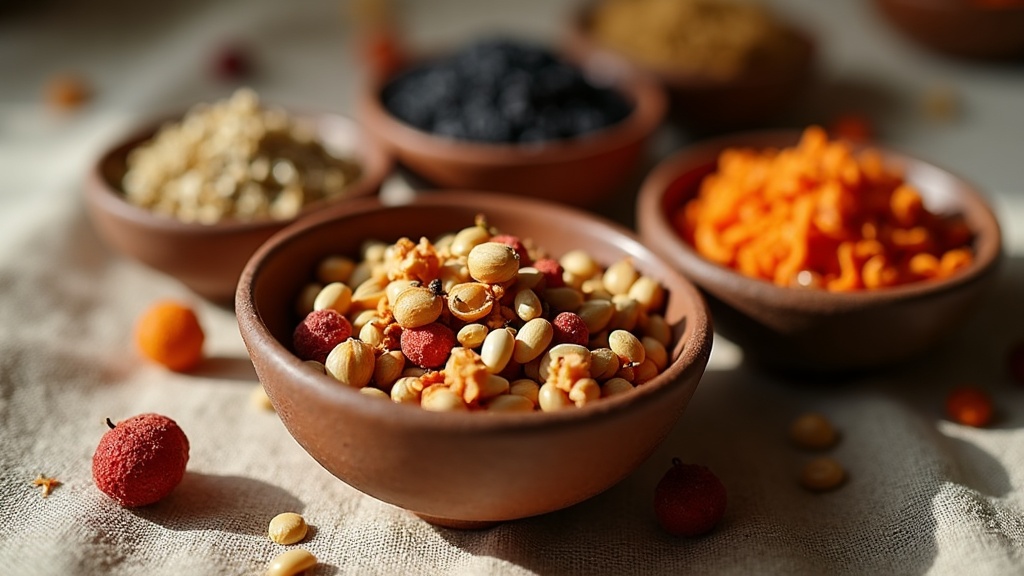
The classical formula for male fertility is Wu Zi Yan Zong Wan (五子衍宗丸, “Five Seeds to Propagate Offspring”). Its five seed ingredients target Kidney Jing directly:
- Goji Berry (Gǒu Qǐ Zǐ, 枸杞子) — nourishes Kidney Yin and Jing
- Cuscuta Seed (Tú Sī Zǐ, 菟丝子) — tonifies Kidney Yang and stabilizes reproductive essence
- Rubus Fruit (Fù Pén Zǐ, 覆盆子) — astringes Jing, supports Yang
- Plantago Seed (Chē Qián Zǐ, 车前子) — clears heat and promotes fluid metabolism, balancing the tonification
- Schisandra Berry (Wǔ Wèi Zǐ, 五味子) — astringes Jing and Qi, nourishes Yin, prevents leakage of essence
For Kidney Yang deficiency with cold signs, You Gui Wan (右归丸, “Restore the Right Kidney”) builds Yang fire and Jing together. For Kidney Yin deficiency with heat signs, Zhi Bai Di Huang Wan (知柏地黄丸) — Rehmannia formula enriched with Phellodendron (Zhī Mǔ, 知母) and Anemarrhena (Huáng Bǎi, 黄柏) — clears empty heat while nourishing Yin. For Damp-Heat, Long Dan Xie Gan Tang (龙胆泻肝汤) clears lower Jiao heat short-course before tonifying. For Liver Qi stagnation, Jia Wei Xiao Yao San (加味逍遥散, “Augmented Free and Easy Wanderer”) regulates Liver and Spleen while clearing heat. When Qi-Blood stasis is prominent (varicocele, scrotal aching, dark tongue), Xue Fu Zhu Yu Tang (血府逐瘀汤) moves Blood to improve testicular microcirculation.
Chinese herbal prescriptions are highly individualized. The formulas mentioned here are classical references — what’s appropriate for your specific presentation depends on your complete pattern diagnosis. Please discuss any herbal protocol with a licensed practitioner before beginning.
Lifestyle as Medicine: The 3-Month Window
The 3-month treatment course isn’t arbitrary — it’s biology. One spermatogenesis cycle takes approximately 72–74 days, plus 14–21 days of epididymal transit. Any intervention — herbal formula, lifestyle change, or supplement — needs that full cycle to show up in a re-test. Lifestyle factors begin modifying the intratesticular environment immediately, even if the counts lag by a full cycle.
Key levers: heat avoidance (laptops off the lap, no hot tubs more than twice weekly, breathable underwear), hydration (3 liters daily supports semen volume), sleep restoration (8 hours — the single most correctable testosterone driver in clinical practice), and eliminating cannabis and alcohol during active treatment.
One caution worth naming explicitly: testosterone replacement therapy (TRT) — gels, injections, pellets — is contraindicated for men who want to conceive. Exogenous testosterone shuts down the HPT axis via negative feedback, leading to azoospermia within 3–6 months in most men. Men with low testosterone who also want fertility should be co-managed with a reproductive endocrinologist using clomiphene or HCG — not TRT.
The Couple’s Frame: Treating Both Sides in Parallel
Fertility is genuinely a team effort. The spermatogenesis timeline syncs well with the egg quality timeline — both require approximately 3 months of sustained treatment — so there’s no reason to treat one partner first and then the other. Both partners can begin simultaneously, and the results from each side contribute to the cumulative outcome.
At Makari Wellness, we treat the male partner in parallel with whatever the female partner is addressing — whether that’s PCOS, endometriosis-related infertility, hormone imbalance, or general fertility acupuncture support. The TCM diagnostic process for the male partner is its own full assessment — pattern differentiation, lifestyle review, and a formula prescription tailored to his specific presentation. Our functional medicine fertility hub covers the full integrated approach.
References
- Maciocia, G. (2011). Obstetrics and Gynecology in Chinese Medicine (2nd ed.). Churchill Livingstone. [Sperm as Kidney Jing product; male pattern differentiation framework]
- Lyttleton, J. (2013). Treatment of Infertility with Chinese Medicine (2nd ed.). Churchill Livingstone/Elsevier. [Ch. 9 — Male Infertility: semen-analysis-mapped patterns, Wu Zi Yan Zong Wan, point protocols] [GAP: no DOI — print text]
- World Health Organization. (2021). WHO Laboratory Manual for the Examination and Processing of Human Semen (6th ed.). WHO Press. [Reference values: morphology 4%, total motility 40%, progressive motility 32%, concentration 16M/mL] [GAP: no inline DOI in vault source]
- [GAP: Clinical evidence for acupuncture improving sperm parameters — WHO 2021 semen analysis outcomes + acupuncture RCT — no specific PubMed ID available in vault sources]
- [GAP: Sperm DNA fragmentation and oxidative stress — clinical outcomes study PubMed ID not available in vault]
Ready to explore your fertility health?
Makari Wellness — Michael Woodworth, M.S., L.Ac. (established 2005)
Specializing in fertility and reproductive health — pattern-precise functional medicine through classical Chinese medicine, without the expensive lab gatekeeping.
Call us: (888) 871-8889
Book online: makariwellness.com/book-appointment
Oceanside: 2111 S. El Camino Real, Suite 301, Oceanside, CA 92054
San Diego: 16486 Bernardo Center Drive, Suite 218, San Diego, CA 92128
This content is for educational purposes and does not constitute medical advice. Acupuncture and Chinese herbal medicine complement but do not replace conventional reproductive or obstetric care. Always consult your healthcare providers about your individual situation.