

Acupuncture Styles & Systems at Makari Wellness in Oceanside & San Diego
At Makari Wellness in Oceanside and San Diego, we practice five acupuncture systems: traditional Chinese medical acupuncture, scalp acupuncture, Japanese meridian therapy, orthopedic acupuncture with dry needling, and Master Tung’s acupuncture. We choose or combine them based on the person in front of us — their condition, their constitution, and how they respond.
- Different acupuncture systems reason about the body in different ways, and each has conditions it is commonly used for.
- Most patients are not treated with just one system; we adapt as we learn how you respond.
- Your first visit is an assessment, so the plan is built around you rather than around a single style.
Why We Use More Than One System
Acupuncture is not one technique. Over centuries and across several countries, distinct traditions developed — each with its own way of assessing a patient and choosing where to place a needle. A shoulder that will not move, a stroke recovering slowly, and a digestive system that has been unsettled for years are different problems, and they often call for different approaches.
Every visit starts with careful assessment: your history, pulse and tongue, palpation of the tissues involved, and, for musculoskeletal complaints, how you move. What we find guides which system leads, which supports, and when to change course. The five systems below are the ones we draw on most. For a shorter look at other styles we use, including ear and electro-acupuncture, see Acupuncture Styles.
Traditional Chinese Medical Acupuncture
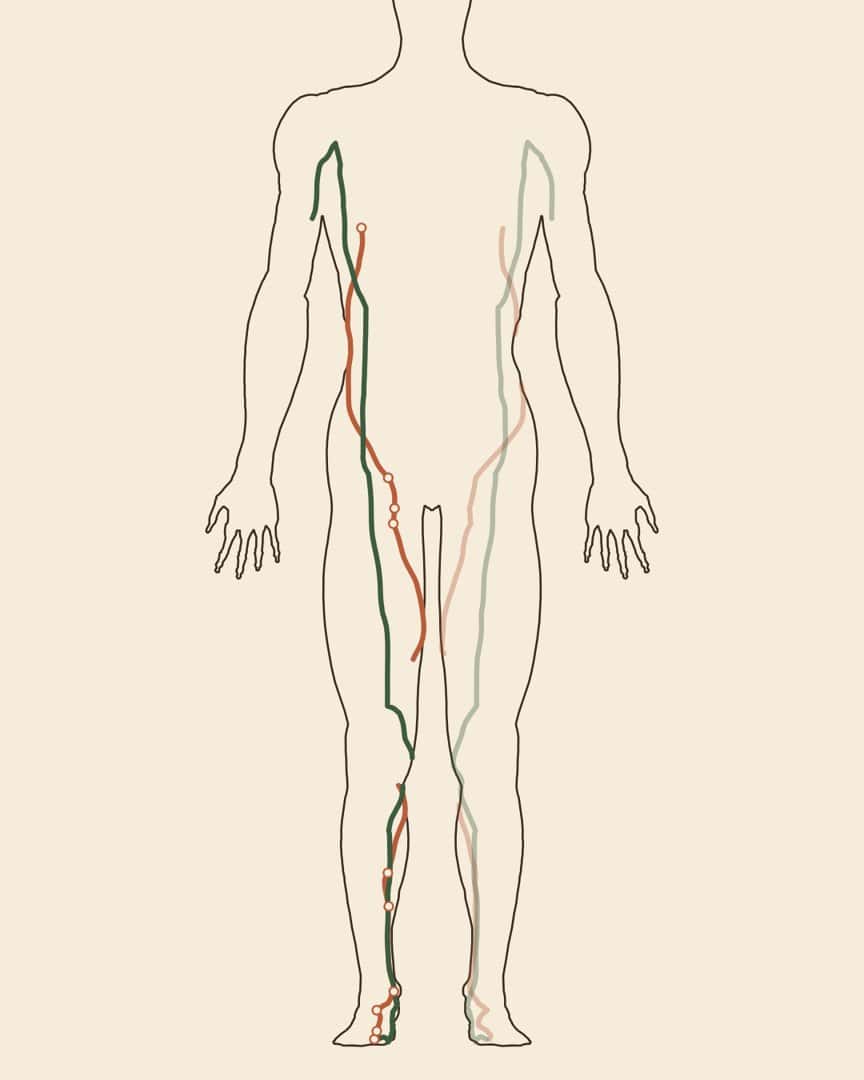
Traditional Chinese medical (TCM) acupuncture is the foundation of our practice. It is built on pattern differentiation (biàn zhèng): rather than naming a single diagnosis and applying a standard protocol, we look at the whole picture — pulse, tongue, sleep, digestion, temperature, emotions — to identify how the body’s functions have become unbalanced. Fine, sterile needles are then placed along the channel network to help restore that balance. For pain and postural tension, we also work with the Sinew Channels, the outer layer of the network that relates to muscle and connective tissue.
Commonly used for:
- Sleep disturbance, stress and anxiety
- Digestive irregularity
- Menstrual and hormonal concerns
- Headaches and fatigue
- Musculoskeletal pain and general resilience
Related pages: Internal Medicine conditions · Our Approach
Scalp Acupuncture Systems
Anatomy: Z-Anatomy, CC BY-SA 4.0
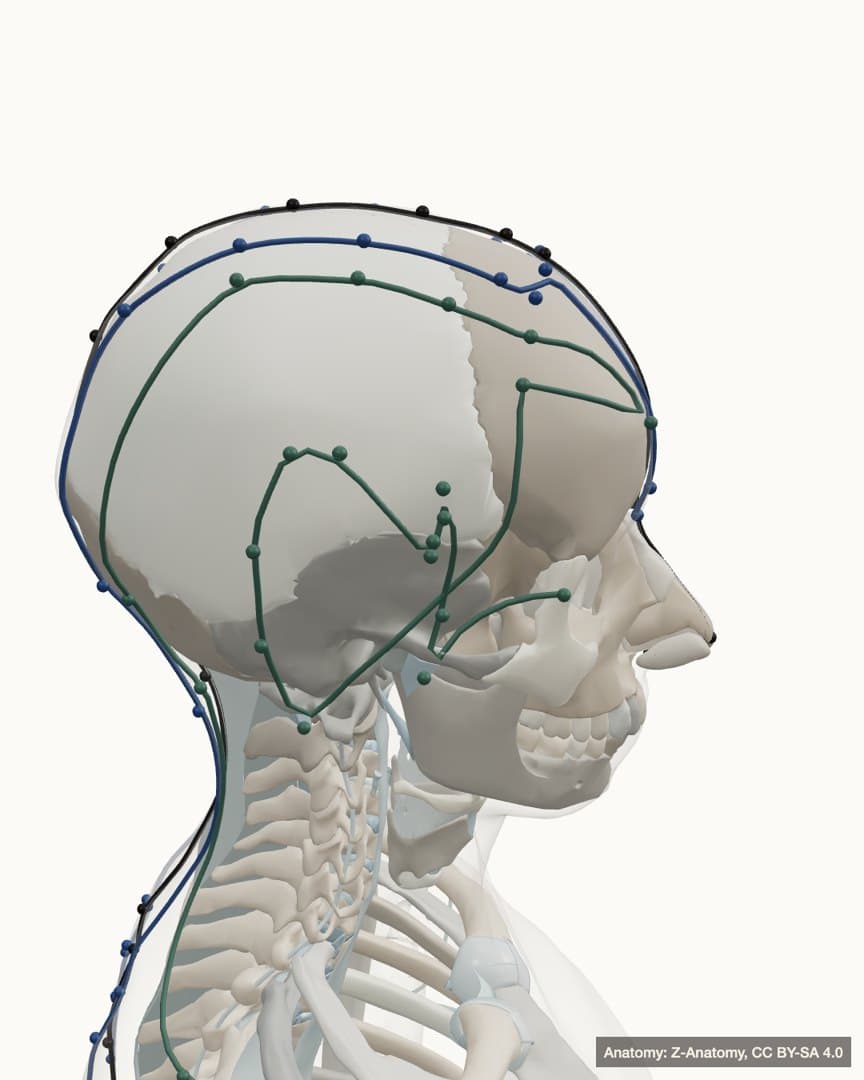
Scalp acupuncture places fine needles along mapped lines and zones of the scalp that correspond to regions of the brain and body. Several scalp systems have developed since the 1950s, and we use more than one: the cortical-mapping lines of the Jiao method, Zhu’s scalp acupuncture, and Yamamoto New Scalp Acupuncture (YNSA), which uses palpation of the neck to guide point selection. Some of these approaches ask you to move the affected limb, or to walk, while the needles are in place.
Commonly used for:
- Stroke recovery and neurological rehabilitation
- Parkinson’s-related symptoms
- Peripheral neuropathy
- Concussion and brain-injury recovery
- Dizziness and some types of headache
Related pages: Neurology & Stroke conditions · Stroke · Parkinson’s disease
Japanese Meridian Therapy
Anatomy: Z-Anatomy, CC BY-SA 4.0
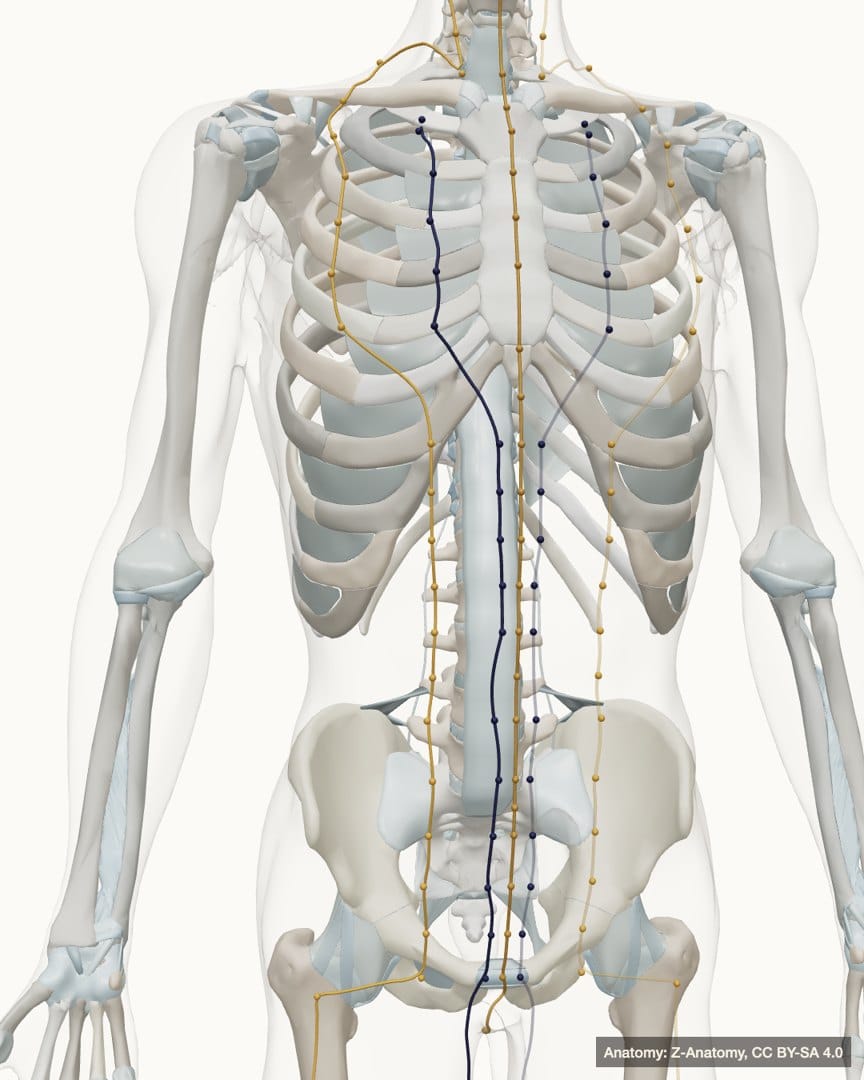
Japanese meridian therapy (keiraku chiryō) is known for a lighter touch. Needling is typically shallow and gentle, often with fewer needles, and treatment is guided by what the practitioner feels rather than by a fixed formula: the pulse, the tissue of the abdomen (hara), and points that are reactive to touch. Matsumoto-style treatment is a well-known example, and the response is checked by palpation during the session so the plan can be adjusted on the spot. Many patients who are sensitive to needling prefer this style.
Commonly used for:
- Digestive complaints such as bloating and heartburn
- Exhaustion and low energy
- Insomnia and anxiety
- Headache and low back pain
- Menstrual concerns and fertility support
Related pages: Fertility & Sexual Health · How It Works
Orthopedic Acupuncture & Dry Needling
Anatomy: Z-Anatomy, CC BY-SA 4.0
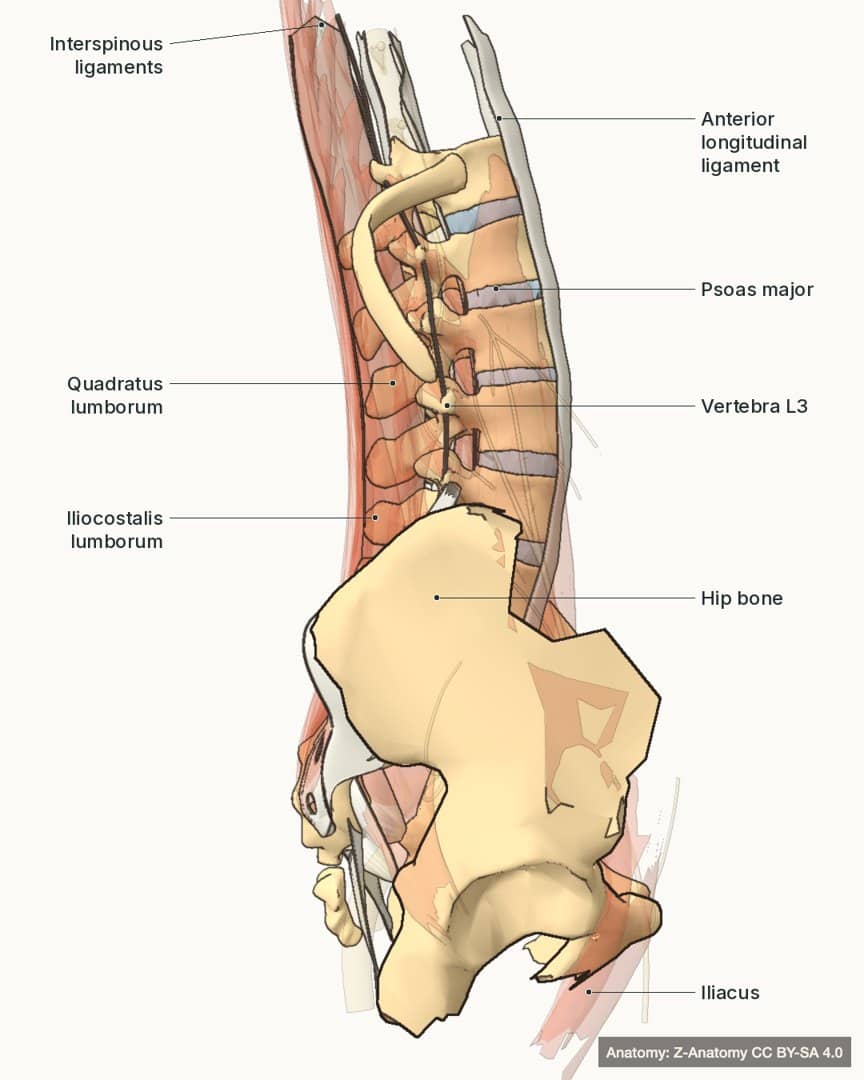
Orthopedic acupuncture focuses on the muscles, tendons, joints and nerves involved in pain and movement. It includes needling of motor points and trigger points — the technique many people know as dry needling — and it is paired with movement assessment and hands-on manual therapy. Dry needling is performed as part of acupuncture practice by a California-licensed acupuncturist; California does not treat it as a separate modality. At Makari Wellness this approach has been part of orthopedic care since the practice opened, and it is often combined with Active Release Techniques (ART) and functional movement work.
Commonly used for:
- Neck, upper-back and low back pain
- Sciatica and bulging-disc symptoms
- Frozen shoulder and tendonitis
- Knee, hip and elbow pain
- Sports injuries and TMJ discomfort
Related pages: Dry Needling · Dry Needling Explained · Dry Needling vs. Acupuncture · Orthopedic & Sports Medicine conditions
Master Tung’s Acupuncture
Anatomy: Z-Anatomy, CC BY-SA 4.0
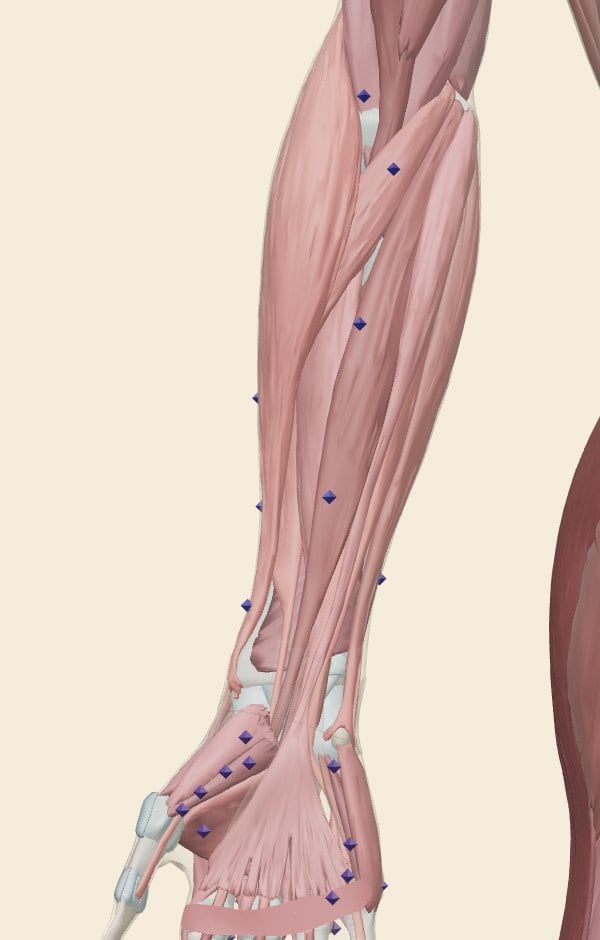
Master Tung’s acupuncture (Dong Shi Qi Xue) is a family-lineage system from Taiwan. Its central idea is that each region of the hands, arms, feet and legs reflects the whole body, so a problem in one area can be addressed by needling points on a limb, often at a distance from where it hurts. Patients are commonly asked to move the sore area right after the needle is placed, so they can notice any change as it happens. It is a precise, efficient approach, and it pairs well with the other systems.
Commonly used for:
- Neck, shoulder and back pain
- Sciatica and knee pain
- Headaches and facial pain
- Some internal-medicine and gynecologic concerns
Related pages: Orthopedic & Sports Medicine conditions · Migraines
How the Systems Combine
These are examples of how we commonly combine systems. Your own plan depends on what we find, and it can change as you respond.
| What brings you in | Systems commonly combined |
|---|---|
| Stroke and neurological recovery | Scalp acupuncture, TCM pattern-based acupuncture, Master Tung’s points |
| Back, neck and shoulder pain | Orthopedic acupuncture and dry needling, Master Tung’s points, manual therapy |
| Sports injuries and tendon problems | Orthopedic acupuncture, Active Release Techniques, functional movement |
| Headache and migraine | Japanese meridian therapy, TCM pattern-based acupuncture, scalp acupuncture |
| Digestion, sleep and stress | TCM pattern-based acupuncture, Japanese meridian therapy |
Other Services at Makari Wellness
Acupuncture is often paired with other care. Depending on your needs, we also offer:
- Chinese herbal medicine — see Herb Directions
- Electro acupuncture
- Moxibustion
- Active Release Techniques (ART)
- Functional movement
- Functional medicine, through the lens of classical Chinese medicine
- Cupping and gua sha
What to Expect at Your First Visit
Your first visit begins with a detailed conversation about your history and goals, followed by pulse and tongue assessment and, when relevant, palpation and movement testing. From there, your practitioner explains what was found and recommends a treatment plan. Sessions typically run 45 to 60 minutes, with needles retained for about 20 to 30 minutes.
Frequently Asked Questions
Is dry needling the same as acupuncture?
They use the same kind of needle, and the techniques can look alike. What differs is the reasoning used to choose the spot. At Makari Wellness, dry needling is performed as part of acupuncture practice by a California-licensed acupuncturist.
Does Japanese-style acupuncture feel different?
Often, yes. The needling is typically shallow and gentle, and the treatment is guided by touch. Many patients who are sensitive to needles find it comfortable, though experiences vary from person to person.
Will I receive more than one style in a visit?
Possibly. We may lead with one system and add another during the same session, or change approach from one visit to the next, depending on how you respond.
How do you decide which system to use?
We base the choice on your history, your pulse and tongue, what we feel on palpation, and how you move. Your response to treatment then guides what we keep and what we change.
This is general wellness information, not medical advice.