

Perimenopause and Menopause: Chinese Medicine Takes the Long View
The Change That Chinese Medicine Has Always Understood
You missed a period. Then another. Your sleep suddenly broke into restless, sweat-soaked fragments. The heat waves come out of nowhere — face flushing, heart racing, then gone as fast as they arrived. Your ob-gyn says everything looks “normal for your age,” and hands you a pamphlet about menopause. You leave the office still not entirely sure what’s happening or why your body feels like it belongs to someone else.
What Western medicine calls the menopausal transition, Chinese medicine has been describing, naming, and treating for well over a thousand years. The insight isn’t just semantic — it shapes how a practitioner looks at your symptoms, what they treat, and how deeply the treatment goes. For millions of women navigating this passage right now, that difference in perspective matters enormously.
Perimenopause and Menopause: What Western Medicine Tells Us
Perimenopause is the endocrine transition that precedes menopause — a gradual unwinding of the hypothalamic-pituitary-ovarian (HPO) axis that can last anywhere from two to ten years. It begins in the mid-40s on average, though the late 30s is not rare. Menopause itself is confirmed only in retrospect: twelve consecutive months without a menstrual period. The average age in the United States is 51.
The hormonal picture is more complex than most women are told. Estrogen doesn’t simply decline — it swings erratically, surging unpredictably high as the pituitary works overtime to recruit remaining follicles, then crashing when that effort fails. Progesterone drops first and most steadily, creating a relative estrogen-dominance phase before the eventual estrogen decline takes over. FSH rises as the brain notices the declining ovarian response. The result is a biological flux that can produce estrogen-excess symptoms (bloating, breast tenderness, heavy cycles) and estrogen-deficiency symptoms (hot flashes, vaginal dryness, insomnia) in the same month — sometimes the same week.
Conventional medicine has evolved meaningfully in its approach to this transition. After the Women’s Health Initiative study raised concerns about synthetic HRT in 2002, the pendulum swung hard toward avoidance. Current thinking — endorsed by the Menopause Society (formerly NAMS) and others — has reconsidered that position for many women. Bioidentical hormone replacement, particularly transdermal estradiol combined with oral micronized progesterone, is now recognized as appropriate and beneficial for symptomatic women under 60 who are within ten years of menopause onset. For women with moderate to severe vasomotor symptoms, bone density concerns, or genitourinary syndrome (vaginal dryness, urinary urgency, painful intercourse), HRT is a reasonable conversation to have with your physician. We coordinate with prescribing providers — HRT and acupuncture are not in conflict.
Where conventional medicine sometimes falls short is in addressing the whole person entering the transition. Two women can have identical lab values and wildly different symptom experiences. The question Chinese medicine asks — and has always asked — is: why?

A Functional Medicine Note: Building the Foundation
From a functional medicine perspective, the severity of menopausal symptoms tracks closely with the state of the adrenal glands going into the transition. Post-menopause, the adrenals become the primary source of sex hormone precursors — DHEA converts to androstenedione, which converts to testosterone and estrone. A woman entering the transition with depleted adrenal reserves (from decades of poor sleep, chronic stress, or overwork) will experience a dramatically harder transition than a woman with healthy adrenal function. This is one of the most clinically important and underappreciated aspects of the menopausal transition.
Key nutritional priorities include: Vitamin D3 with K2 for bone density, omega-3 fatty acids for cardiovascular protection, magnesium for sleep and bone mineralization, and phytoestrogens from whole food sources — edamame, ground flaxseed, sesame — which may modestly buffer vasomotor symptoms. Glycemic stability matters more than most women realize: hot flash frequency worsens with blood sugar swings, and insulin sensitivity improvement can reduce symptoms meaningfully even without hormonal intervention.
How Chinese Medicine Understands This Transition
Classical Chinese medicine names this phase the Second Spring — not a shutting down but a reorientation of energy. The cosmological framework is elegant: Tian Gui (天癸), the heavenly water that initiates and sustains reproductive function, completes its forty-year arc. Blood, which has flowed downward each month as menstruation, now pauses that outward movement. The accumulated Jing — the constitutional essence that has sustained decades of fertility — reorganizes its purpose.
This is not a pathology. It is a passage that Chinese medicine has always understood as natural. The clinical question is not how do we stop this from happening but how do we support the body through it with minimal turbulence.
Four dominant patterns characterize the menopausal transition in TCM. Most women present with a primary pattern and elements of one or two others simultaneously.
Kidney Yin Deficiency — 肾阴虚 (Shèn Yīn Xū)
Kidney Yin is the body’s cooling, moistening, and nourishing foundation. When Yin declines — which happens naturally through the menopausal transition and is accelerated by years of insufficient rest, overwork, or chronic depletion — a specific symptom constellation emerges. The classic hot flash in this pattern is the internal heat that arises when Yin can no longer anchor and balance Yang. In TCM terms, this is called Empty Heat or Deficiency Fire (虚热, Xū Rè): not the roaring fire of an excess condition but the flickering heat of a system running on insufficient reserves.
Kidney Yin deficiency presents as hot flashes that tend to be most intense in the late afternoon and evening, night sweats that drench the bedclothes and disrupt sleep, dryness throughout — dry skin, dry vaginal mucosa, dry eyes, dry mouth at night — and a particular quality of insomnia characterized by restlessness, vivid dreaming, and early waking. The tongue in this pattern tends to be red with little coating; the pulse thin and rapid.
Kidney Yang Deficiency — 肾阳虚 (Shèn Yáng Xū)
Not all menopausal presentations are hot. A significant subset of women experience what might be called the cold menopause: persistent fatigue, cold extremities, low back aching that feels deep and constitutional, weight gain with a cold sensation in the body, low libido, and a kind of flat, colorless low mood distinct from the fire and anxiety of the Yin-deficient picture. This is Kidney Yang deficiency — the warming, activating, metabolic dimension of Kidney function declining.
These women tend to run cold even when they occasionally experience a hot flash; they feel worse in winter; their energy peaks never quite recover. In functional medicine terms, this pattern correlates closely with adrenal and thyroid insufficiency. The tongue in this pattern is pale and moist; the pulse deep and slow.
Mixed Kidney Yin and Yang Deficiency — the Er Xian Tang Pattern
The most clinically common menopausal presentation is neither purely hot nor purely cold — it is both, simultaneously or alternating. Hot flashes and night sweats coexist with fatigue and achiness. Dry mucous membranes coexist with low back cold. Insomnia with restlessness by night, exhaustion by day. This mixed pattern — Kidney Yin and Yang both declining, with Empty Heat arising from the Yin insufficiency — is exactly what the classical formula Er Xian Tang (二仙汤, Two Immortals Decoction) was designed to address. Its name refers to the two “immortal” herbs at its core: Xian Mao and Yin Yang Huo.
Heart-Kidney Disharmony — 心肾不交 (Xīn Shèn Bù Jiāo)
In the Five Phase model, the Heart belongs to Fire and the Kidney belongs to Water. Under normal circumstances, these two organs communicate and regulate each other: Water rises to cool the Heart; Heart Fire descends to warm the Kidneys. This is the Water-Fire axis. When Kidney Yin declines significantly, Kidney Water can no longer rise to cool Heart Fire. Heart Fire begins to rise without restraint. The result is severe insomnia (particularly inability to fall asleep, a Heart Shen pattern), significant palpitations — especially at night — anxiety that can escalate to panic, and hot flashes that are accompanied by cardiac awareness and emotional volatility. This pattern responds to a different herbal strategy than pure Kidney deficiency.

Reading Your Symptoms Through a TCM Lens
Chinese medicine excels at making sense of symptom clusters that seem unrelated in Western framing. Consider why hot flashes happen at night specifically: in TCM, nighttime is the domain of Yin. As the sun sets and the world quiets, Yin energy should be rising to govern rest and cooling. When Yin is deficient, this expected nighttime cooling fails — and the already-insufficient Yin cannot contain the Yang, which rises as heat. Night sweats are not a mystery; they are exactly what the theory predicts.
The insomnia of Kidney Yin deficiency tends to wake you at 2–4 AM — when Yin should be deepest but can’t hold the Yang down. The palpitations of Heart-Kidney disharmony worsen at night when lying down draws circulation inward, with no Water rising to balance the Heat. Mood changes, brain fog, joint aching, hair thinning, vaginal dryness, reduced libido — every symptom has a coherent organ-system explanation. And that explanation determines which points are selected, which herbs are prescribed, and in what order the treatment proceeds.
Acupuncture for Perimenopause and Menopause
Acupuncture works at the level of the Water-Fire axis — the fundamental Kidney-Heart relationship that governs the menopausal transition. For patients interested in an evidence-informed approach to reproductive health, the point selection in menopause treatment reflects both classical TCM rationale and a coherent physiological logic.
The core protocol for menopausal support includes points that nourish Kidney Yin and Yang simultaneously while calming Heart Shen and regulating the Chong and Ren vessels — the two extraordinary meridians that govern blood, reproduction, and uterine function:
- KD-3 (Taixi, 太溪) — Source point of the Kidney; tonifies Kidney Qi, Yin, and Yang
- KD-6 + LU-7 (Zhaohai 照海 + Lieque 列缺) — confluent pair opening the Yin Qiao vessel and Ren Mai; moistens Yin throughout; the classical combination for hot flashes and night sweats
- HT-7 (Shenmen, 神門) — Source point of the Heart; calms Shen; settles palpitations; the Fire-Water bridge
- PC-6 (Neiguan, 内關) — opens the chest; calms palpitations; paired with HT-7 for insomnia and anxiety
- SP-6 (Sanyinjiao, 三陰交) — meeting point of the three Yin channels; tonifies Liver, Spleen, and Kidney Yin; regulates the uterus
- CV-4 (Guanyuan, 關元) — Gate of the Source; tonifies Original Qi and Kidney Yang; supports Chong and Ren
- BL-23 (Shenshu, 腎俞) — back-shu of the Kidney; directly tonifies Kidney Yin and Yang; moxibustion here for Yang-deficient cold presentations
Hot flash-predominant presentations add KD-7 (Fuliu, 復溜) — specific for night sweats — and SJ-5 (Waiguan, 外關), which opens the Yang Wei vessel to regulate alternating hot and cold. For severe insomnia, Yin Tang and Si Shen Cong calm the Shen, and KD-1 (Yongquan, 湧泉) grounds the rising Yang downward.
For women who are also navigating hormone-related conditions earlier in life — including PCOS, endometriosis, or hormonal imbalance — these conditions often predict which menopausal pattern will be most prominent. The Wood-sphere (Liver) patterns of PCOS and endometriosis tend to transition into the more volatile, emotionally charged perimenopausal presentations. Early treatment shapes the transition.
Chinese Herbal Medicine for Menopause: The Key Formulas
Chinese herbal medicine has developed sophisticated multi-herb formulas that address the menopausal transition at the root level — not by suppressing symptoms but by restoring the Yin-Yang balance that makes symptoms necessary in the first place.
Er Xian Tang — Two Immortals Decoction (二仙汤)
Er Xian Tang is the menopause formula in the Chinese classical tradition — specifically designed for the mixed Kidney Yin and Yang deficiency pattern that is most common in clinical practice. Its architecture is elegant: it simultaneously warms and nourishes, clears Empty Heat without suppressing Yang, and tonifies without creating stagnation.
- Curculigo rhizome (Xian Mao, 仙茅) — warms Kidney Yang; the “first immortal”
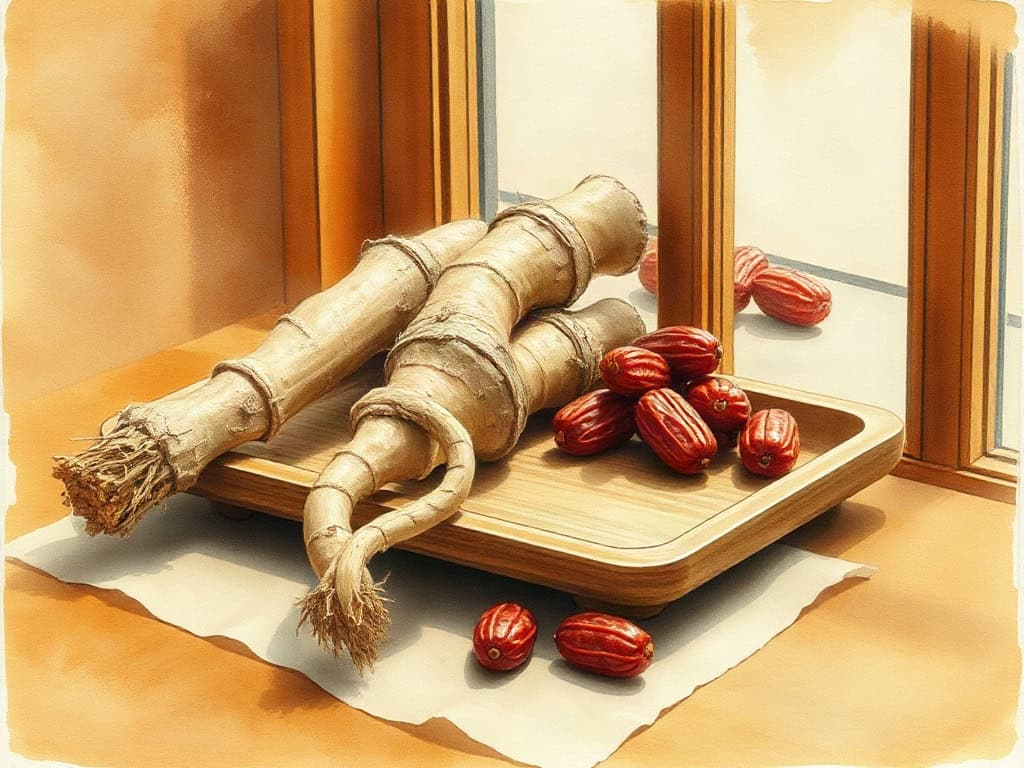
- Epimedium (Yin Yang Huo, 淫羊藿) — warms and tonifies Kidney Yang; the “second immortal”; supports adrenal and reproductive function
- Morinda root (Ba Ji Tian, 巴戟天) — tonifies Kidney Yang more gently; nourishes Jing; strengthens the lower back
- Phellodendron bark (Huang Bai, 黄柏) — clears Empty Heat from the Kidney; cools the lower Jiao; the necessary counterbalance to the warming herbs
- Anemarrhena rhizome (Zhi Mu, 知母) — nourishes Yin and clears Empty Heat; works synergistically with Huang Bai to prevent the Yang tonics from generating excess heat
- Dong quai root (Dang Gui, 当归) — nourishes Blood; bridges Yin and Yang; regulates the Chong vessel
The elegance of Er Xian Tang lies in its ability to hold two seemingly contradictory therapeutic intentions simultaneously: warming Yang and clearing Yin-deficiency heat within a single prescription. This reflects the genuine clinical reality of most menopausal presentations — which are not purely hot or purely cold but both.
Tian Wang Bu Xin Dan — Emperor of Heaven’s Special Pill (天王补心丹)
For the Heart-Kidney disharmony pattern — severe insomnia, pronounced palpitations, anxiety with hot flashes, emotional volatility — Tian Wang Bu Xin Dan (天王补心丹) is the classical formula of choice. It nourishes Kidney Yin and Heart Blood, anchors the Shen, and clears Heart Fire through a broad-spectrum formula that has been used for centuries in exactly this clinical scenario. This is the formula for the Heart that has lost the Water that should cool it.
Zhi Bai Di Huang Wan (知柏地黄丸)
When the pattern is pure Kidney Yin deficiency with Empty Heat — predominantly hot and dry, minimal cold signs, thin body type — Zhi Bai Di Huang Wan adds Phellodendron (Huang Bai, 黄柏) and Anemarrhena (Zhi Mu, 知母) to the classical Liu Wei Di Huang base for targeted Empty Heat clearing alongside deep Yin nourishment.
Jia Wei Xiao Yao San — Augmented Rambling Powder (加味逍遥散)
For women whose menopausal transition features significant emotional volatility, irritability, breast tenderness, or a history of PMS and Liver Qi stagnation — the Wood-sphere perimenopausal picture — Jia Wei Xiao Yao San (加味逍遥散, Augmented Free and Easy Wanderer) courses Liver Qi, nourishes Liver Blood, and clears Heat from constraint. This is often the formula for early perimenopause when the cycle is still present but estrogen erraticism is driving emotional chaos.
Chinese herbal prescriptions are highly individualized. The formulas mentioned here are classical references — what’s appropriate for your specific presentation depends on your complete pattern diagnosis. Please discuss any herbal protocol with a licensed practitioner before beginning.
The Longer View
Chinese medicine’s deepest contribution to menopause may be philosophical before it is clinical. In a culture that treats menopause as a medical event requiring management, classical Chinese medicine offers a different frame: a transition, not a disease. The Second Spring is not a diminishment but a transformation — the Jing that sustained decades of fertility reorganizing for the chapter ahead.
This doesn’t mean the symptoms aren’t real or shouldn’t be treated. It means they can be met with something other than alarm. The hot flash is the body communicating that the Yin-Yang balance needs attention. The practitioner’s job — and the patient’s — is to listen, support the transition, and step into the other side with reserves intact. At Makari, the pulse and tongue ARE our hormonal and metabolic evaluation — Kidney Yin and Yang depletion, the Heart-Kidney axis, Liver Qi dynamics, and the Chong Mai’s retreat through the perimenopausal arc give us a complete functional picture without requiring lab panels. If you’re also working with an MD or functional medicine provider tracking hormones, adrenal reserve, thyroid, or bone density, that picture is complementary — we address the same terrain through pattern. The goal is not to stop the clock but to ensure the transition happens from a position of health, not depletion.
If you are also supporting fertility or managing reproductive health conditions prior to this transition, our functional medicine fertility pillar page explains how we integrate these approaches across the full arc of reproductive health. Related conditions we commonly treat include amenorrhea and recurrent pregnancy loss — both of which involve the same Kidney Jing and Chong/Ren vessel dynamics that are central to menopausal care.
References
- Harlow SD, et al. (2012). Executive summary of the Stages of Reproductive Aging Workshop + 10: addressing the unfinished agenda of staging reproductive aging. Menopause. 19(4):387–395.
- The Menopause Society (formerly NAMS). (2023). The 2023 Menopause Society Position Statement on Hormone Therapy. Menopause. 30(6):573–584.
- [GAP: Er Xian Tang clinical trial — RCT evidence for menopausal symptoms; no PubMed ID available from vault sources]
- [GAP: KD-6 / LU-7 Yin Qiao vessel pairing for hot flashes — systematic review citation not available in vault]
- [GAP: Zhi Bai Di Huang Wan RCT evidence for KD Yin xu hot flash presentation — no DOI available from vault]
- [GAP: Maca root published evidence for hot flash reduction — study citation not available from vault sources]
- Zhu L, et al. (2019). Acupuncture for menopausal hot flushes: clinical evidence synthesis. [GAP: journal and DOI not confirmed in vault; claim requires citation verification]
- Manson JE, et al. (2013). Menopausal hormone therapy and health outcomes during the intervention and extended poststopping phases of the WHI randomized trials. JAMA. 310(13):1353–1368.
Ready to explore your fertility health?
Makari Wellness — Michael Woodworth, M.S., L.Ac. (established 2005)
Specializing in fertility and reproductive health — pattern-precise functional medicine through classical Chinese medicine, without the expensive lab gatekeeping.
Call us: (888) 871-8889
Book online: makariwellness.com/book-appointment
Oceanside: 2111 S. El Camino Real, Suite 301, Oceanside, CA 92054
San Diego: 16486 Bernardo Center Drive, Suite 218, San Diego, CA 92128
This content is for educational purposes and does not constitute medical advice. Acupuncture and Chinese herbal medicine complement but do not replace conventional reproductive or obstetric care. Always consult your healthcare providers about your individual situation.