

Diabetic Retinopathy and Chinese Medicine: The Xiao Ke Pattern and the Retinal Collaterals
A Vascular Complication With Deep Roots
Diabetic retinopathy is one of the leading causes of preventable vision loss in working-age adults. The blood vessels that nourish the retina weaken, leak, and form microaneurysms — silently at first, then progressively. Non-proliferative DR (NPDR) is the early-to-moderate stage; proliferative DR (PDR) the advanced phase, with fragile new vessel growth that can bleed and scar. Chinese medicine sees both as expressions of the same underlying terrain — and offers a framework for understanding that terrain alongside conventional care.
Diabetic retinopathy is a complication of uncontrolled blood sugar. Regular ophthalmologic monitoring and blood glucose management are non-negotiable primary interventions. Everything here is supportive and adjunctive — not a replacement.
How Chinese Medicine Reads Diabetic Retinopathy
Root: Xiao Ke (Xiāo Kě, 消渴) — the wasting-thirsting disorder. This is the classical Chinese framework for diabetes mellitus: Kidney Yin deficiency at the root cannot hold the metabolic fire; fluids are lost; the tissue substrate is depleted. The classical text maps three organ territories — Lung, Stomach, and Kidney — to the upper, middle, and lower wasting presentations.
Local manifestation: Blood stasis in the retinal collaterals (Luò Mài Xuè Yū, 络脉血瘀). The classical text is direct: “In chronic Xiao Ke, there will be Blood stasis” (消渴日久,必有瘀血). When Qi is insufficient to move Blood and constitutional Yin deficiency thickens its quality, stasis forms in the peripheral collateral network. The retinal microvasculature is exactly this collateral territory — micro-hemorrhages and microaneurysms are Blood stasis events.
Secondary layer: Spleen Qi deficiency (Pí Qì Xū, 脾气虚) and Dampness. The Spleen’s impaired transformative function generates Dampness — a pathological accumulation that turbids the blood and mirrors the insulin resistance, dyslipidemia, and metabolic syndrome picture. This is the third layer of the DR terrain.
The Dzung Lens: Which Regions Are Involved?
Dzung Van Nguyen maps five regions of the eye to five organ systems: the pupil to the Kidney (Water), the blood vessels to the Heart (Fire), the iris to the Liver (Wood), the sclera to the Lung (Metal), and the eyelids to the Spleen (Earth). In DR, the primary pathology lives in the retinal blood vessels (Heart), the constitutional root in the Kidney, and the metabolic layer in the Spleen. Three of the five regions are directly implicated — a picture the acupuncture protocol must address at all three levels.
Acupuncture for Diabetic Retinopathy: M48, Scalp Vision Area, and the Electro Protocol
MA48 (Micro Acupuncture 48) — developed by Andy Rosenfarb, ND, LAc — is a 48-point distal microsystem Makari specializes in for degenerative eye disease. Within the MA48 classification, DR falls in the Bleeding/Clogging category: the dual pathology of vascular fragility (Bleeding) and collateral stasis (Clogging).
Each organ in the MA48 system has two poles — A points (distal, Yang) for functional and sensory presentations; B points (proximal, Yin) for structural and constitutional depth. For DR, the Xiao Ke root demands B-point emphasis:
- HT-A (Heart — sensory): the primary MA48 vascular point for the eye; addresses the Heart’s governance of the retinal blood vessels in the acute Clogging/Bleeding layer.
- KI-B (Kidney — constitutional): the deepest point in the Xiao Ke protocol; addresses Kidney Yin deficiency as the root of the wasting-thirsting pattern driving all downstream pathology.
- SP-B (Spleen — constitutional): addresses the metabolic layer — Spleen Qi deficiency, Dampness generation, and the classical teaching that the Spleen “controls blood within the vessels.”
Periorbital adjunct points may be added to support local circulation. Protocol: 34-gauge half-inch needles at ~45° onto periosteum, 30-minute retention. Response is assessed within 1–4 treatments; approximately 15% of patients do not respond to MA48 treatment.
Scalp Vision Area and Electro-Stimulation
The occipital Vision Area (枕上視覺區) in the Dr. Karl Tai lineage — 1 cm lateral to the external occipital protuberance, 4 cm superior — is included in every Makari eye protocol. The standard Vision Three Needles (視三針) set is applied. Dense-Disperse wave electro-stimulation (“Pulling Qi Method,” 抽气法) drives enhanced retinal blood flow via galvanic current stimulation of the optic nerve. GB-20 (*Fēngchí*) anchors the electro pair. For chronic vascular degeneration, 1–4 Hz is the standard parameter (sustained tissue remodeling and parasympathetic regulation). Patients often report a subjective brightening experience during the Vision Area electro phase.
Chinese Herbal Medicine: The Two-Layer Approach
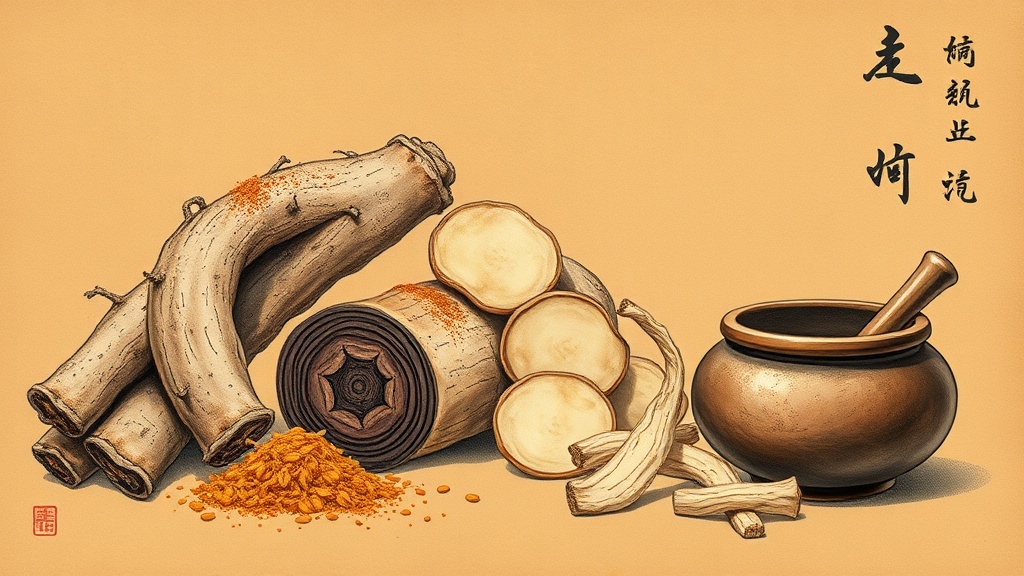
Tian Hua Fen (Tiān Huā Fěn, 天花粉) — trichosanthes root — is the classical Xiao Ke herb; it generates fluids, clears Heat, and addresses the wasting-thirsting root pattern. Listed in Tang dynasty texts as the primary herb for this presentation.
Huang Qi (Huáng Qí, 黄芪) — astragalus — tonifies central Qi and supports the Spleen’s transformative function; classically described as stabilizing the vascular membrane, making it a natural fit for the hemorrhagic risk dimension of DR.
San Qi (Sān Qī, 三七) — notoginseng — is the classical “blood in the collaterals” herb. Its defining quality is moving Blood stasis without exhausting the Blood — critical in a patient already constitutionally depleted by Xiao Ke. Extensively explored in Chinese clinical literature for retinal vascular applications.
Dan Shen (Dān Shēn, 丹参) — salvia miltiorrhiza — activates Blood, removes stasis, and cools the Blood. Paired with San Qi, it forms the core collateral-opening layer. Specific formula selection is made after a complete individual pattern assessment — these herbs illustrate the clinical logic, not a fixed prescription.
Functional Medicine Support
From a functional medicine perspective, DR involves two converging terrain challenges: retinal antioxidant capacity (the RPE is among the most oxidatively stressed tissues in the body; supporting its protective systems is a meaningful priority) and microvascular perfusion support (capillary integrity, blood viscosity, and endothelial function all influence retinal vascular health beyond glycemic control alone). Both layers are addressed alongside — not instead of — conventional metabolic management.
What the Research Shows
A 2026 systematic review in Frontiers in Medicine by Bautista-Hernández MA and colleagues examined acupuncture for inflammation-related ocular conditions. Their conclusion: current evidence is insufficient to make definitive claims. We share this honestly. The M48 protocol for diabetic retinopathy is a clinical conversation grounded in classical theory and experience — not a promise, and not a replacement for ophthalmologic monitoring and metabolic management. Frontiers in Medicine, 2026.
Curious? Let’s Talk.
If you or someone you love is navigating diabetic retinopathy and wondering what integrative acupuncture and herbal support might look like, we’d love to have that conversation.
The M48 protocol isn’t a promise — it’s a conversation. One grounded in classical theory, clinical experience, and an honest engagement with the evolving science.
Makari Wellness — Michael Woodworth, M.S., L.Ac. (established 2005)
Specializing in degenerative eye disease via the M48 protocol
Call us: (888) 871-8889
Book online: makariwellness.com/book-appointment
Oceanside: 2111 S. El Camino Real, Suite 301, Oceanside, CA 92054
San Diego: 16486 Bernardo Center Drive, Suite 218, San Diego, CA 92128
This content is educational and does not constitute medical advice. Acupuncture and herbal medicine are not replacements for conventional ophthalmologic care. Always continue your care with your ophthalmologist.