

The Five Officials: Understanding the Zang-Fu Organ Systems
In classical Chinese medicine, the organs are not merely anatomical structures — they are officials in a body-state. Each one carries a specific civic function, a psycho-spiritual faculty, and a set of tissues and sense organs under its governance. The Huang Di Nei Jing — Su Wen (Plain Questions), compiled over two thousand years ago, gives each organ its job description with striking precision: the Kidney holds technical skill, the Liver plans and deliberates, the Heart is the sovereign from whom all clarity radiates.
When patients come to us at Makari Wellness with symptoms that have escaped a clean biomedical diagnosis — fatigue that won’t resolve, insomnia that cycles, anxiety without a cause, hormonal disruption, or recurring illness — we look to these five officials and ask: which one is failing, and why is the whole body-state suffering as a result?
This post walks through each of the five Zàng (藏) organs — the five Yin organs responsible for storing and transforming essence, qi, blood, and spirit — in Sheng (generation) cycle order: Water → Wood → Fire → Earth → Metal. For each organ we describe what it governs in the body, the psycho-spiritual faculty it houses, the symptoms patients commonly recognize in themselves, and how we approach treatment at Makari Wellness.
The five Zang store essence-qi without draining — they are full but never replete.
— Su Wen, Chapter 11
Read through all five. You may find yourself — or people you love — in more than one. That is not unusual. These systems nourish each other and check each other; when one slips, others compensate, and compensation creates its own set of signals. Classical diagnosis reads the whole picture.
💧 The Kidney — Water Phase
WATER · WINTER · 5–7 PM ORGAN CLOCK
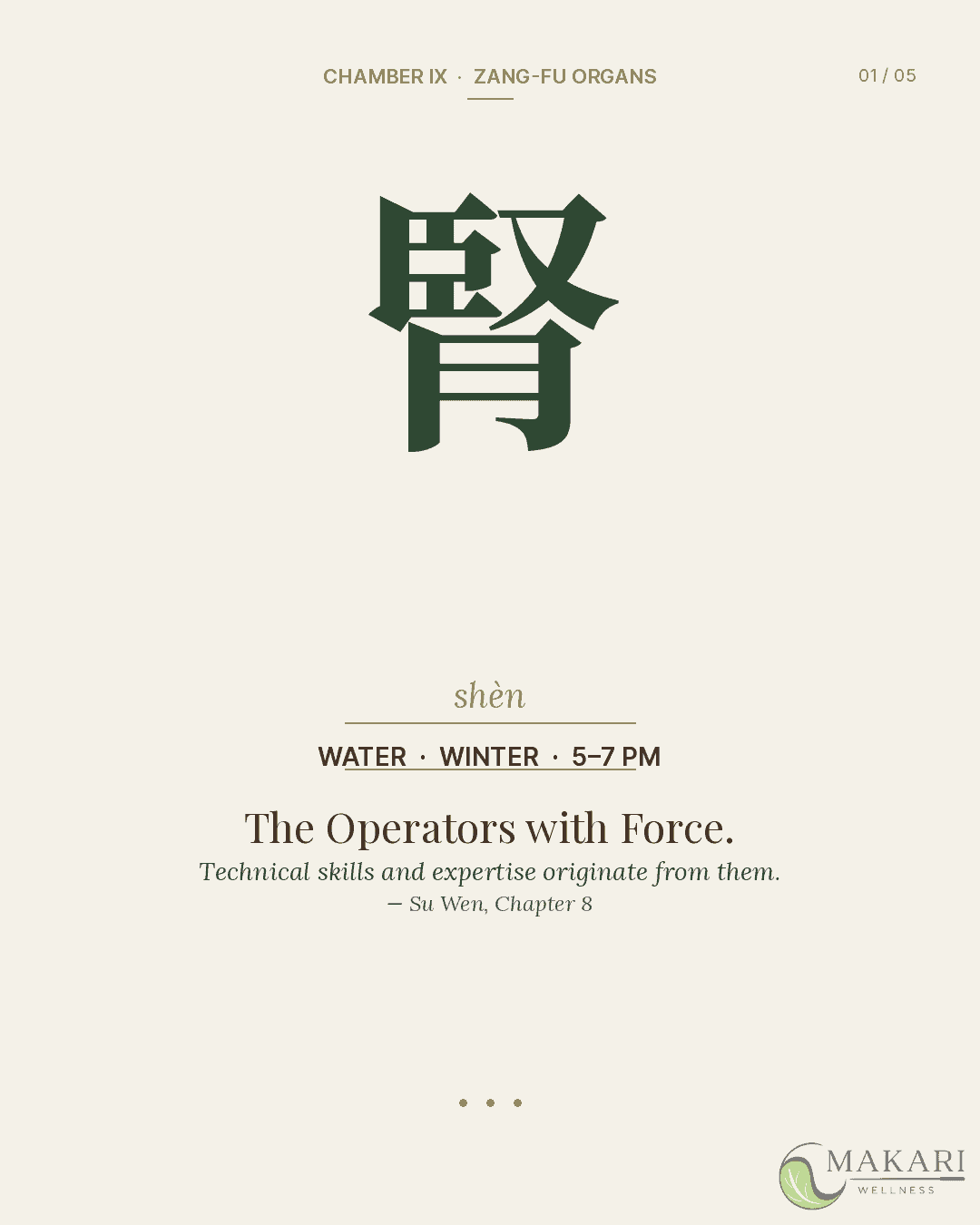
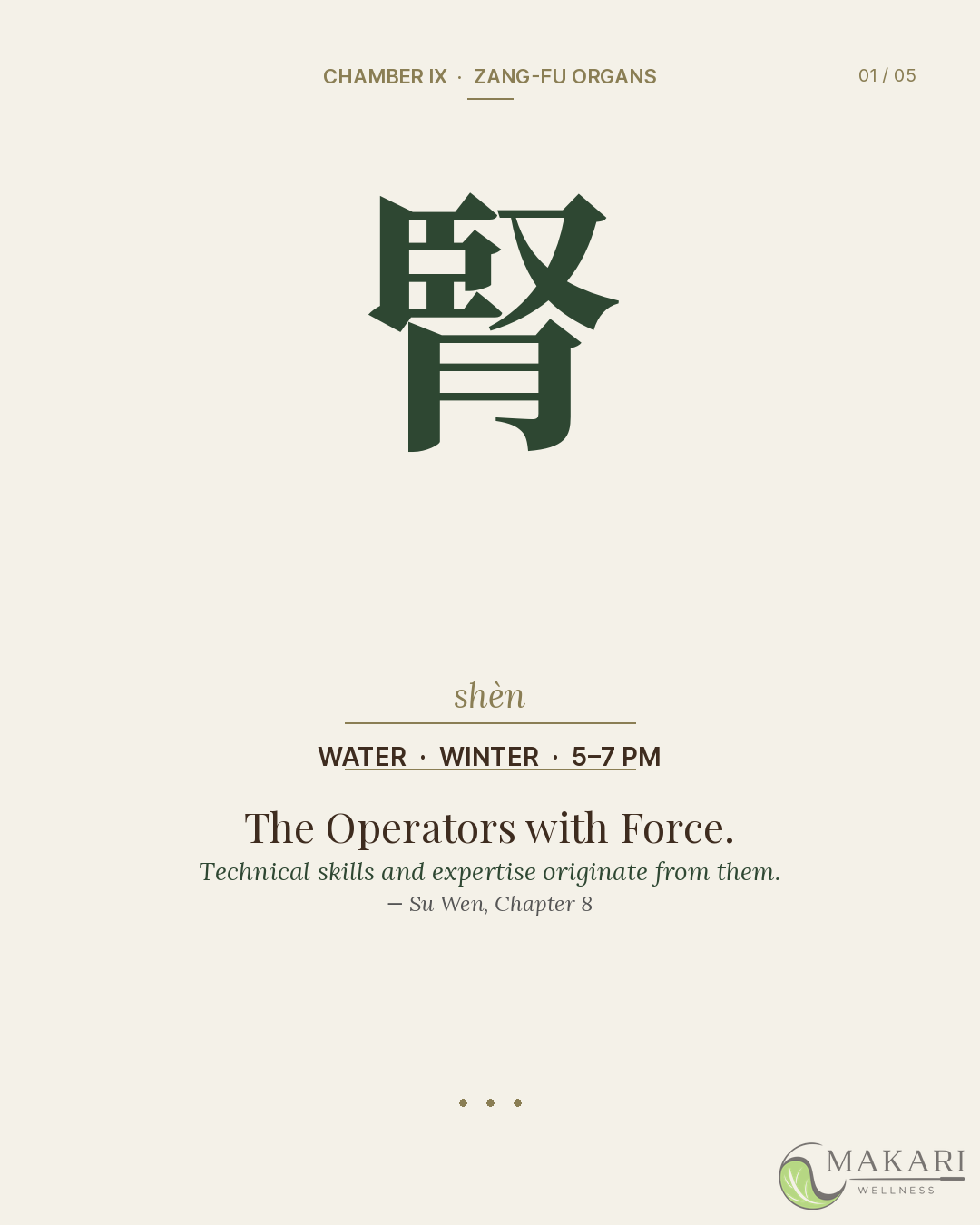
The Kidneys are the officers with force; technical skills and expertise originate from them.
— Su Wen, Chapter 8
The Kidney is the root of life — the storehouse of Jing (essence), the constitutional reserve you were born with and draw on across a lifetime. In classical thinking, the Kidney governs two poles: Kidney Yang (the warming, activating fire at the gate of life) and Kidney Yin (the cool, moistening, nourishing substance that anchors Yang and prevents it from burning unchecked). Every organ system ultimately depends on Kidney Yin and Yang as its foundation.
The Kidney is also the organ most directly linked to aging. Classical texts describe how Kidney Jing naturally declines across seven-year cycles in women and eight-year cycles in men — expressed in the gradual changes in hair, bone density, reproductive capacity, and hearing that we tend to attribute simply to “getting older.” Many of these changes are, from a classical standpoint, addressable.
What the Kidney Governs
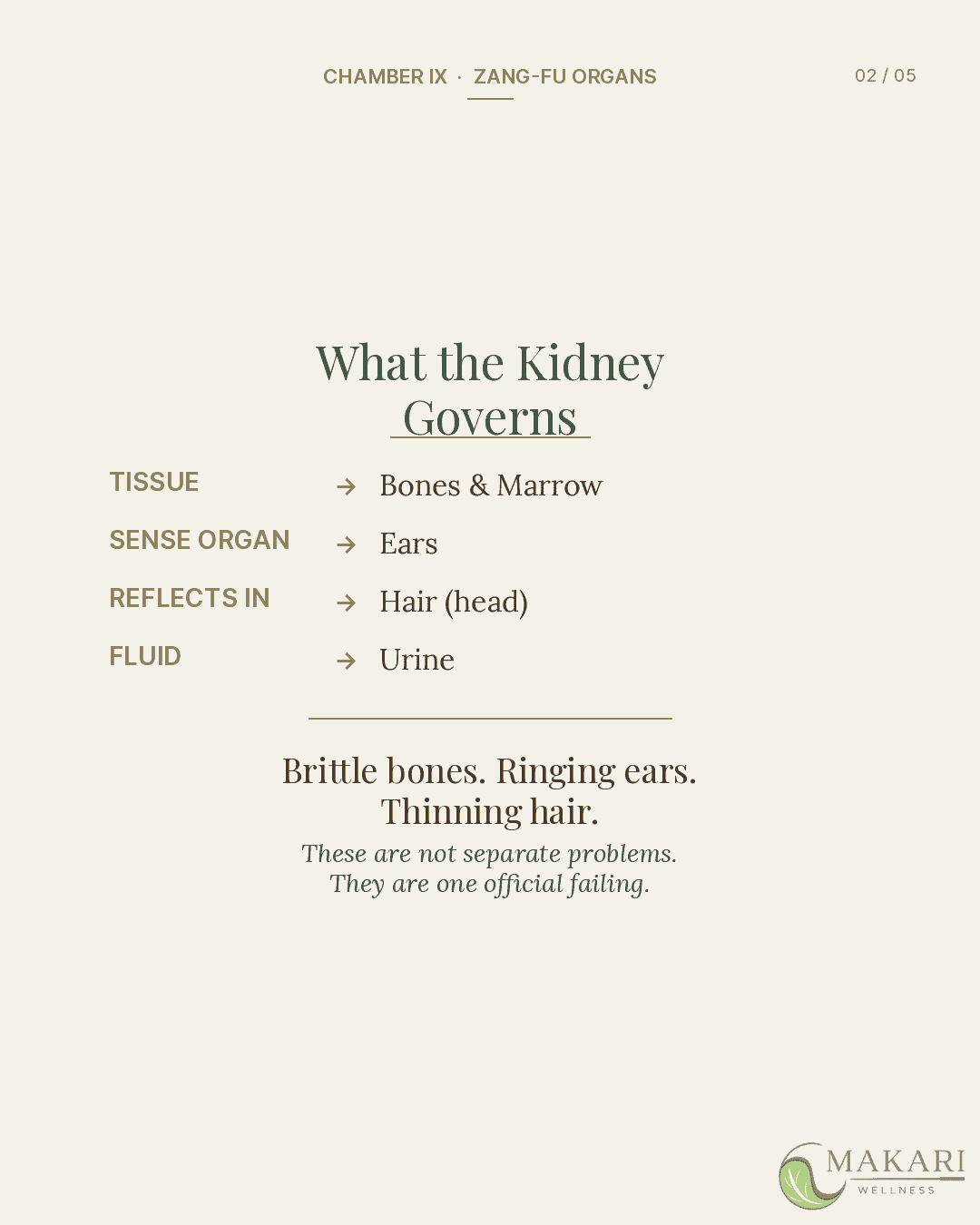
- Body Tissue → Bones & Marrow (including the brain, which classical medicine calls the “sea of marrow”)
- Sense Organ → Ears
- Reflects In → Head hair
- Fluid → Urine
- Paired Fu Organ → Urinary Bladder
- Emotion → Fear
- Flavor → Salty
The Spirit: 志 Zhì — Will & Determination
The Kidney stores the Zhì — the faculty of will, determination, and the drive to persist through difficulty. When Kidney qi is robust, courage and focused intention arise naturally; you can see a goal through, sustain effort under pressure, and recover from setbacks. When the Kidney depletes, the Zhì fails: chronic fear (especially existential or survival-level fear), overwhelm, an inability to follow through on commitments, or a sense that life is fundamentally unsafe. “The Kidney stores the Zhì.” — Ling Shu, Chapter 8
What Patients with Kidney Imbalance Often Notice
- Lower back pain or weakness that feels deep and achy — not muscular, but as if it comes from inside the bones; worse with fatigue, better with rest
- Knee pain or weakness, especially going downstairs or after prolonged sitting
- Feeling cold all the time, particularly in the feet, lower legs, and lower back — cold that blankets get inside
- Frequent urination, especially at night (waking once or more to use the bathroom)
- Hearing changes: ringing or buzzing in the ears (tinnitus), especially a low pitch; gradual hearing loss
- Premature graying, thinning hair, or hair loss disproportionate to age
- Decreased libido; fertility challenges; irregular or absent periods; early menopause symptoms
- Bone density concerns; teeth that feel sensitive or weaken earlier than expected
- Profound fatigue that rest doesn’t fully resolve — the kind where you wake up tired
- Chronic low-grade fear or anxiety that feels existential rather than tied to any specific worry
- In children: delayed developmental milestones, recurrent bedwetting, or poor bone growth
- Night sweats and afternoon heat sensations (Yin deficiency type) OR cold limbs and aversion to cold (Yang deficiency type)
When the Kidney Fails
Kidney Yang Deficiency — The Cold Pattern:
- Cold lower back and knees — feeling cold from the inside out
- Frequent pale urination; possibly nocturia (waking at night to urinate)
- Profound fatigue, especially in the morning or after exertion
- Cold limbs; desire for warmth and dislike of cold weather
- Low libido; sexual dysfunction; poor sperm motility in men
- Early-morning loose stools (5 AM diarrhea is a classic Kidney Yang sign)
- Edema in the lower body; puffiness around the ankles
- Low voice; lack of motivation or drive
This pattern is common in people who have chronically overworked, lived in cold and damp environments, consumed excessive cold or raw foods over many years, or who carry constitutional Kidney Yang weakness.
Kidney Yin Deficiency — The Heat Pattern:
- Night sweats — waking damp or hot in the early hours
- Afternoon or evening heat sensation (“steaming bones”) without fever
- Tinnitus — typically high-pitched, persistent
- Insomnia: difficulty staying asleep, vivid dreams, waking around 2–4 AM
- Dry mouth and throat, especially at night
- Scanty, dark urine
- Low back ache with a sensation of heat
- In women: irregular cycles, reduced menstrual flow, or hot flashes
Yin deficiency patterns often develop through sustained stress, chronic illness, excessive sexual activity, stimulant use, or simply the natural Yin depletion of middle age. The pattern frequently underlies insomnia, anxiety, and menopausal symptoms that fail to respond to conventional approaches.
🌿 The Liver — Wood Phase
WOOD · SPRING · 1–3 AM ORGAN CLOCK
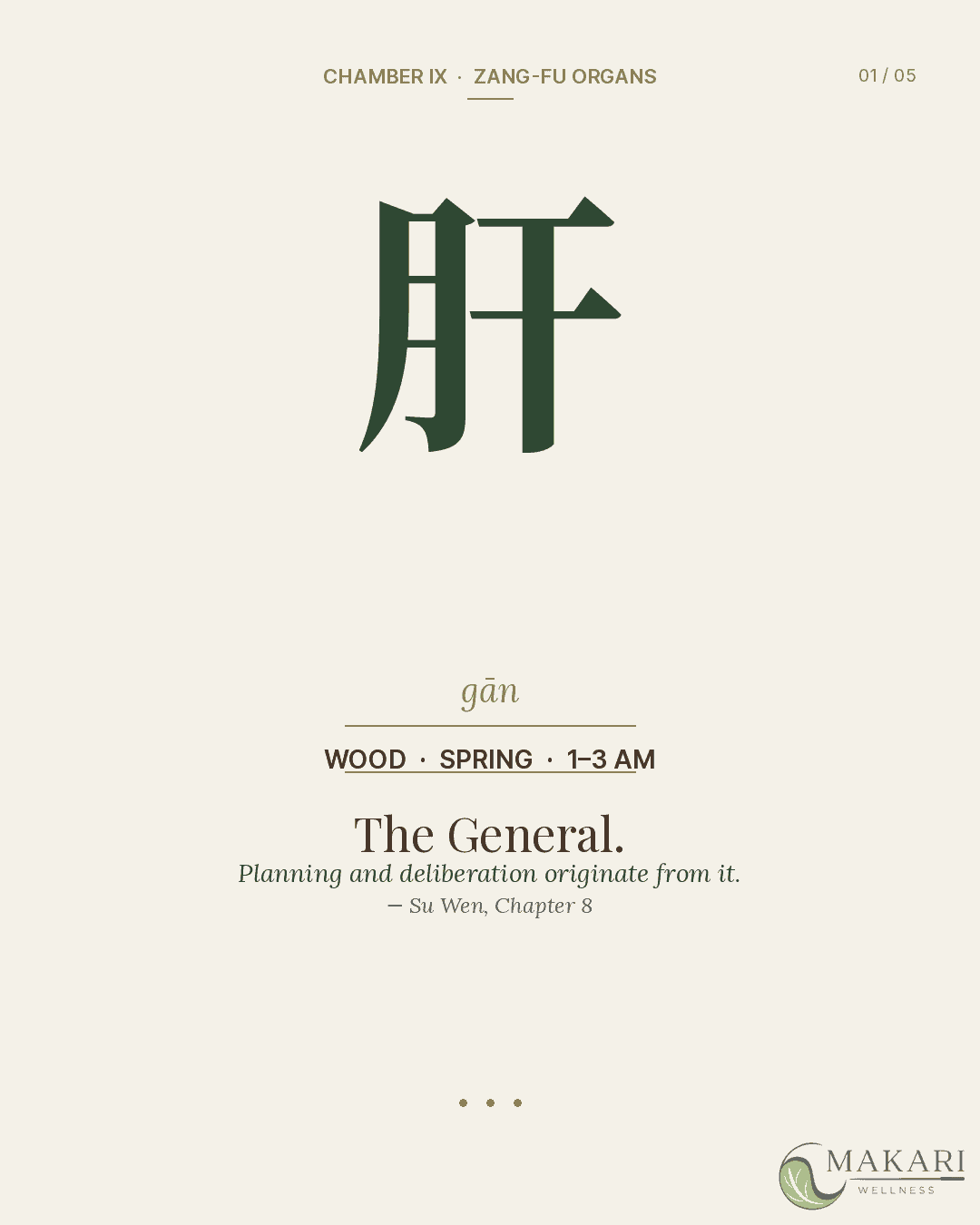
The Liver is the general; planning and deliberation originate from it.
— Su Wen, Chapter 8
The Liver is the general of the body-state — the strategic mind that plans, coordinates, and ensures smooth flow. Its primary function in classical medicine is ensuring the free coursing of qi: when the Liver is functioning well, qi and blood move freely through the body, emotions rise and resolve naturally, digestion is smooth, and the tendons are supple. When the Liver fails in its coursing function, qi stagnates — and stagnant qi is one of the most common patterns driving clinical complaints in modern patients.
Stress, frustration, emotional suppression, irregular eating, overwork, and insufficient sleep — all the hallmarks of modern life — are the primary insults to the Liver system. This makes Liver Qi Stagnation arguably the most prevalent pattern in contemporary clinical practice.
What the Liver Governs
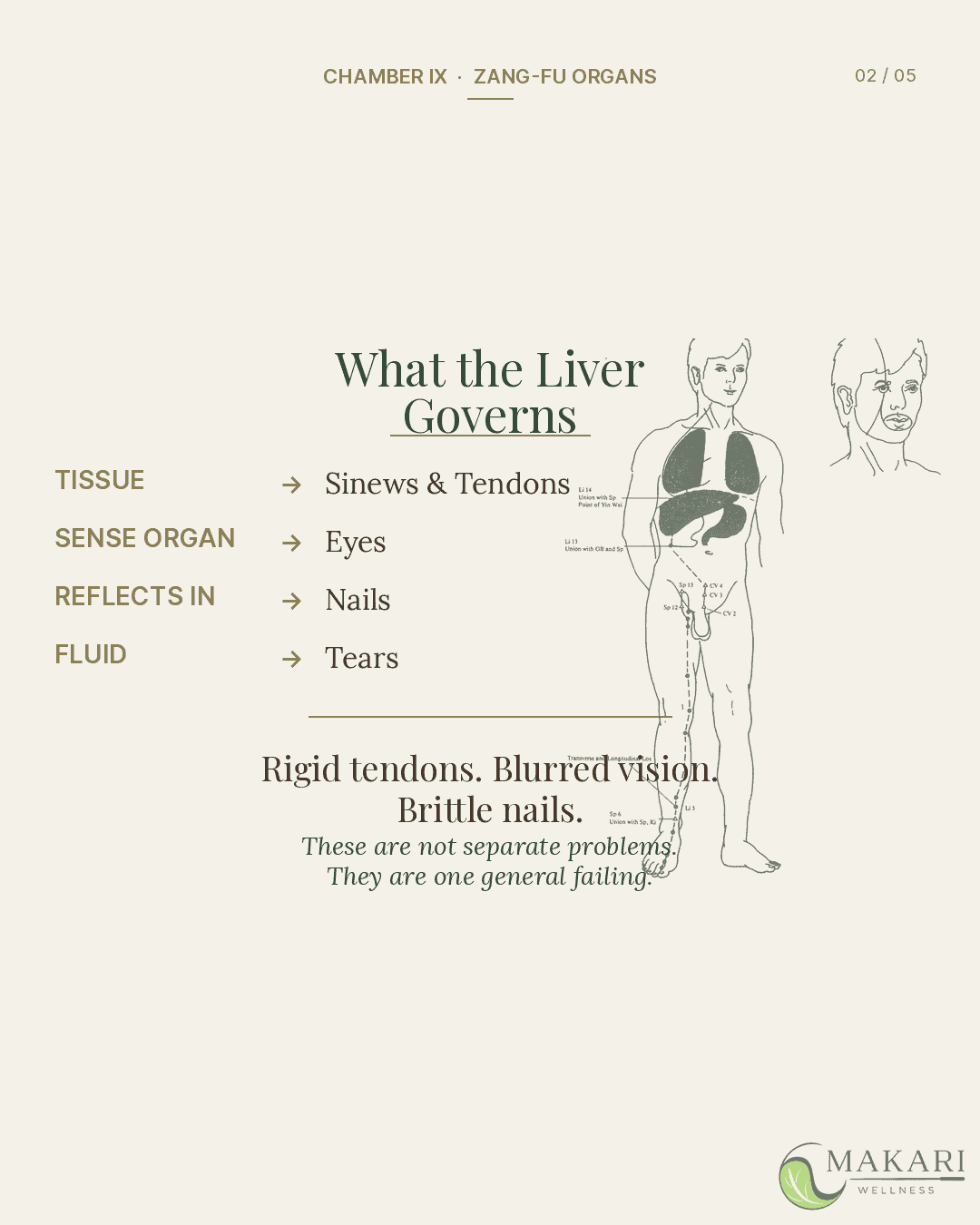
- Body Tissue → Sinews & Tendons (all connective tissue, flexibility, and movement)
- Sense Organ → Eyes
- Reflects In → Nails
- Fluid → Tears
- Paired Fu Organ → Gallbladder (the Liver plans; the Gallbladder decides and acts)
- Emotion → Anger (in balance: appropriate assertion; in excess: rage, resentment, irritability)
- Flavor → Sour
The Spirit: 魂 Hún — The Ethereal Soul
The Liver stores the Hún — the Ethereal Soul — the faculty that enables us to project forward in time, to plan and dream and create. The Hún is said to “come and go” (it is less fixed than the Corporeal Soul stored in the Lung), which is why vivid, narrative dreaming is associated with the Liver. When Liver blood is sufficient, the Hún is anchored at night: sleep is restful and dreams are organized. When Liver blood is deficient, the Hún wanders during sleep, producing insomnia — especially the characteristic 1–3 AM waking — unrestful sleep, and creative or motivational blocks during the day. “The Liver stores blood; blood is the dwelling of the Hún.” — Ling Shu, Chapter 8
What Patients with Liver Imbalance Often Notice
- Waking between 1–3 AM unable to fall back asleep — the Liver’s organ clock window
- Chronic tension in the neck, shoulders, and upper trapezius — especially worsening under stress
- Tightness or aching along the sides of the ribcage (hypochondriac pain)
- Feeling irritable, frustrated, or quick to anger without necessarily knowing why — then feeling guilty about the reaction
- Frequent sighing (the body’s attempt to move stagnant chest qi)
- Eye fatigue, blurred vision, floaters, or dry eyes — especially after screen time or under stress
- Menstrual irregularity: painful cramps, clotting, PMS (mood shifts the week before), early or late cycles, breast tenderness
- Bloating during or after meals, especially when stressed — the Liver overacts on the digestive system (Spleen/Stomach)
- A persistent sense of being stuck — in a job, a relationship, a creative project — with no clear path forward
- Brittle nails with vertical ridging
- Emotional sensitivity that swings dramatically with the menstrual cycle
- Dry or tight tendons; poor flexibility; tendon injuries that are slow to heal
When the Liver Fails
Liver Qi Stagnation — The Stuck Pattern:
- Irritability, frustration, or chronic low-level anger
- Hypochondriac (rib-side) tightness or pain
- Frequent sighing
- PMS — emotional instability, breast distension, cramping before the period
- Bloating and digestive irregularity, especially under stress
- Feeling stuck, unable to make decisions or act on plans
- Tight throat (‘plum-pit qi’ — the classical term for globus sensation)
Liver Qi Stagnation is the most commonly seen pattern in our practice. Left untreated, stagnant qi generates heat (Liver fire), or congeals blood (Liver blood stasis) — both more complex patterns that take longer to address.
Liver Blood Deficiency — The Dry, Empty Pattern:
- Fatigue, especially in the evening
- Pale, brittle nails; pale inner eyelids
- Floaters in vision; blurred vision; dry eyes
- Insomnia — especially 1–3 AM waking or unrefreshing sleep with vivid dreams
- Scanty menstruation or absent periods
- Numbness or tingling in the hands and feet
- Anxiety without a clear cause; tendency toward timidity
- Muscle cramps or spasms
Blood deficiency patterns are common in women with heavy periods (which depletes blood over time), people who are chronically sleep-deprived, and those recovering from illness or surgery.
❤️ The Heart — Fire Phase
FIRE · SUMMER · 11 AM–1 PM ORGAN CLOCK
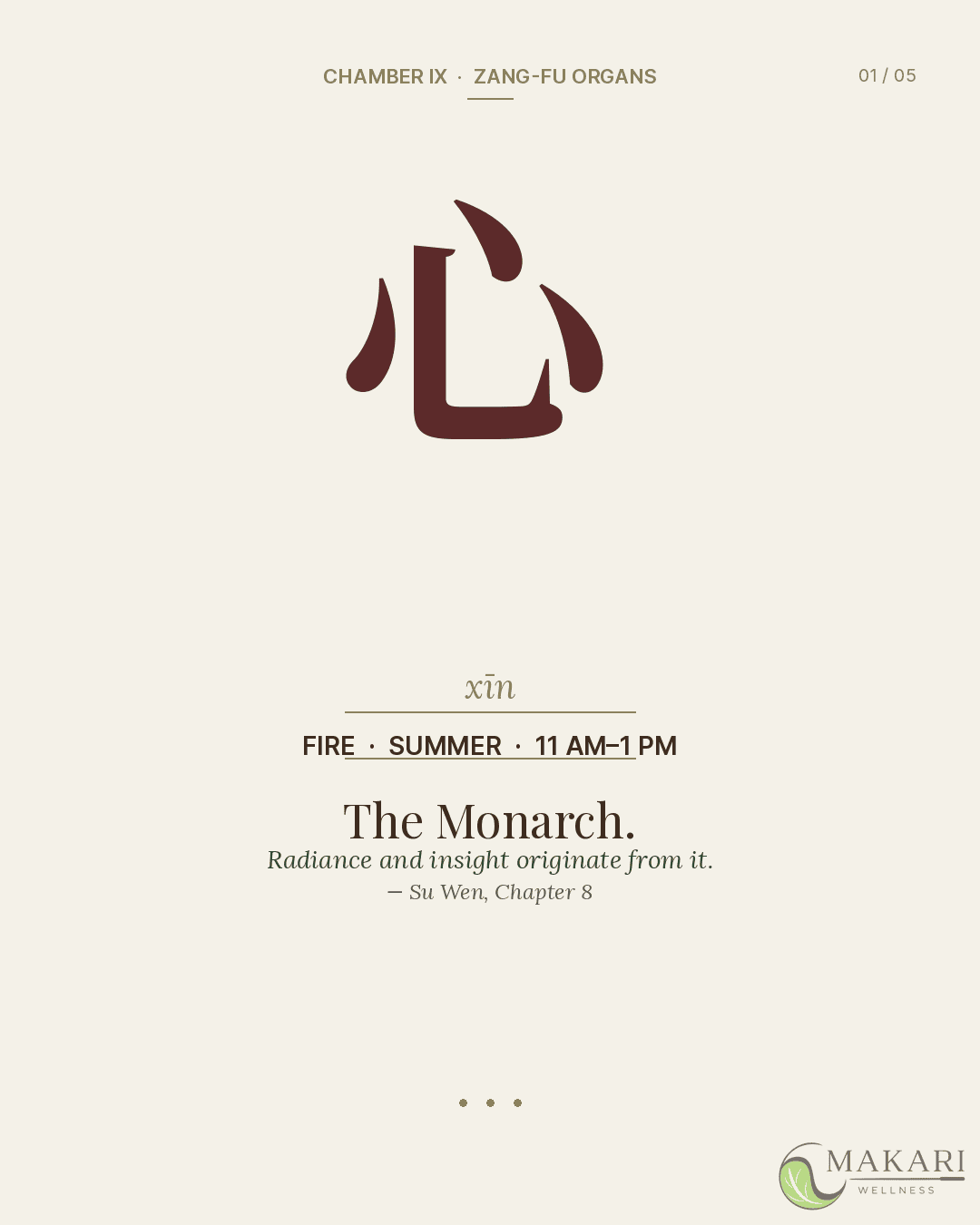
The Heart is the sovereign ruler; the radiance of the spirit emanates from it.
— Su Wen, Chapter 8
In classical Chinese medicine, the Heart is not merely a pump — it is the emperor of the body-state. The Heart houses the Shén (spirit, consciousness, presence), and all other organs derive their clarity from the Heart’s settled sovereignty. When the emperor is calm and clear, the whole court functions: the mind concentrates, sleep is deep and undisturbed, relationships are nourishing, and a fundamental capacity for joy pervades daily life.
The Heart governs the blood vessels — not just the physical circulation, but the quality of blood available to nourish the mind and spirit. Heart blood deficiency is a common cause of anxiety and insomnia that does not respond to conventional anxiolytics or sleep aids, because the problem is not chemical regulation but the absence of a nourishing substance anchoring the spirit.
What the Heart Governs
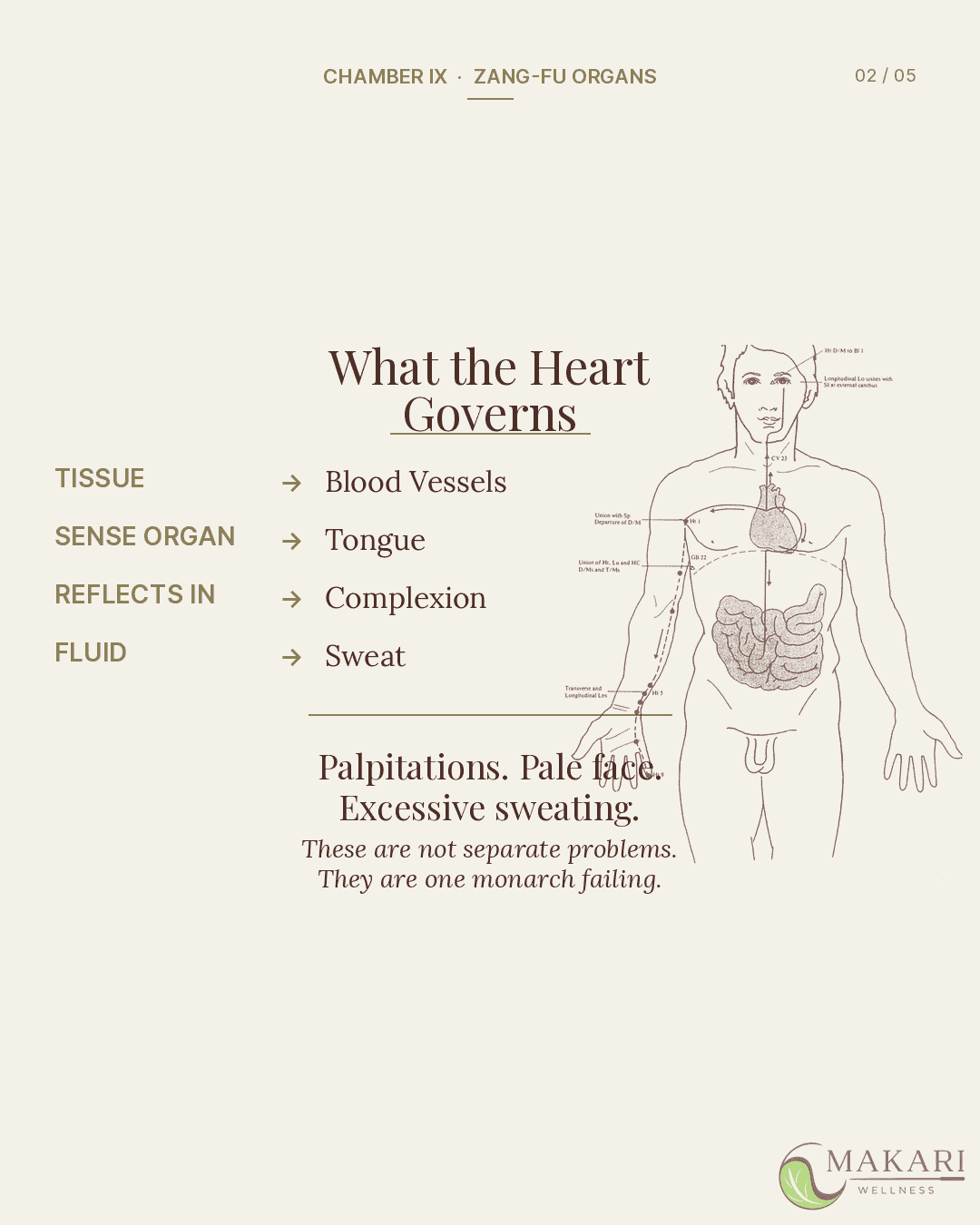
- Body Tissue → Blood vessels (governs pulse quality and circulation)
- Sense Organ → Tongue (speech, taste, articulation; the Heart manifests in the tongue’s color and coating)
- Reflects In → Complexion (facial color is the primary indicator of Heart blood vitality)
- Fluid → Sweat (“sweat is the fluid of the Heart” — excessive sweating can deplete Heart qi)
- Paired Fu Organ → Small Intestine (separates the pure from the impure — both in digestion and in mental discrimination)
- Emotion → Joy (in balance: genuine contentment; in excess or deficiency: manic elation, or inability to feel joy)
- Flavor → Bitter
The Spirit: 神 Shén — The Sovereign Spirit
The Heart stores the Shén — the unified spirit and conscious presence. In classical medicine, all of what we call “mental health” lives under the Heart’s governance: the clarity of thought, the stability of mood, the capacity to be present and in relationship with others. When the Shén is settled in a well-nourished Heart, the person shines — literally; classical texts say you can see the Shén in the eyes. When the Heart is disturbed or deficient, the Shén cannot rest: anxiety that has no external cause, insomnia, scattered or looping thoughts, palpitations, and a felt sense of being disconnected from oneself. “The Heart stores the vessels; the vessels are the dwelling of the Shén.” — Ling Shu, Chapter 8
What Patients with Heart Imbalance Often Notice
- Palpitations — becoming aware of your heartbeat when you shouldn’t be; irregular, skipped, or racing beats, especially with emotional stress
- Anxiety or panic that feels physical rather than cognitive — starting in the chest without a thought precipitating it
- Difficulty falling asleep because the mind continues running when the body is ready to stop
- Waking in the early hours (especially 11 PM–1 AM, the Heart/Small Intestine clock window) with a racing heart
- Tip of the tongue is noticeably red, or persistent mouth ulcers (the tongue is the Heart’s sense organ)
- Sweating disproportionate to exertion — sweating during ordinary activity, or night sweats
- Memory lapses: difficulty concentrating, forgetting words mid-sentence, or short-term memory gaps
- A pale or sallow complexion with no vibrancy (Heart blood deficiency), or flushed cheeks (Heart fire)
- Feeling emotionally flat — unable to access joy, pleasure, or genuine warmth in connection
- Stuttering or speech hesitation under pressure
- A general sense of being unsafe, even in objectively safe circumstances
- Sensitivity to heat; easily overstimulated by noise, screens, or emotional intensity
When the Heart Fails
Heart Qi or Yang Deficiency — The Weak, Cold Pattern:
- Palpitations, especially on exertion or emotional stress
- Shortness of breath on moderate activity
- Generalized fatigue; a sense of reduced vital force
- Cold hands; poor peripheral circulation
- Spontaneous sweating throughout the day
- Timidity, fearfulness, or lack of confidence
- Low, soft voice
Heart Yang Deficiency can develop from constitutional weakness, prolonged illness, extreme grief, or long-term deficiency of all organ qi reaching into the Heart. It is a more serious pattern and often requires warming treatment.
Heart Yin Deficiency or Fire — The Agitated, Hot Pattern:
- Insomnia — difficulty falling asleep, or frequent waking; racing mind at night
- Night sweats; feeling hot in bed
- Palpitations, especially lying down or at rest
- Anxiety, restlessness, or a feeling of internal heat in the chest
- Mouth ulcers that recur — especially on the tip of the tongue
- Red tip of the tongue; rapid, thin pulse
- Agitation, irritability, or emotional reactivity
Heart Yin Deficiency is common in people who have sustained chronic stress, worked long hours with insufficient rest, or experienced prolonged emotional disturbance. The pattern is frequently misidentified as generalized anxiety disorder.
🌾 The Spleen — Earth Phase
EARTH · LATE SUMMER · 9–11 AM ORGAN CLOCK
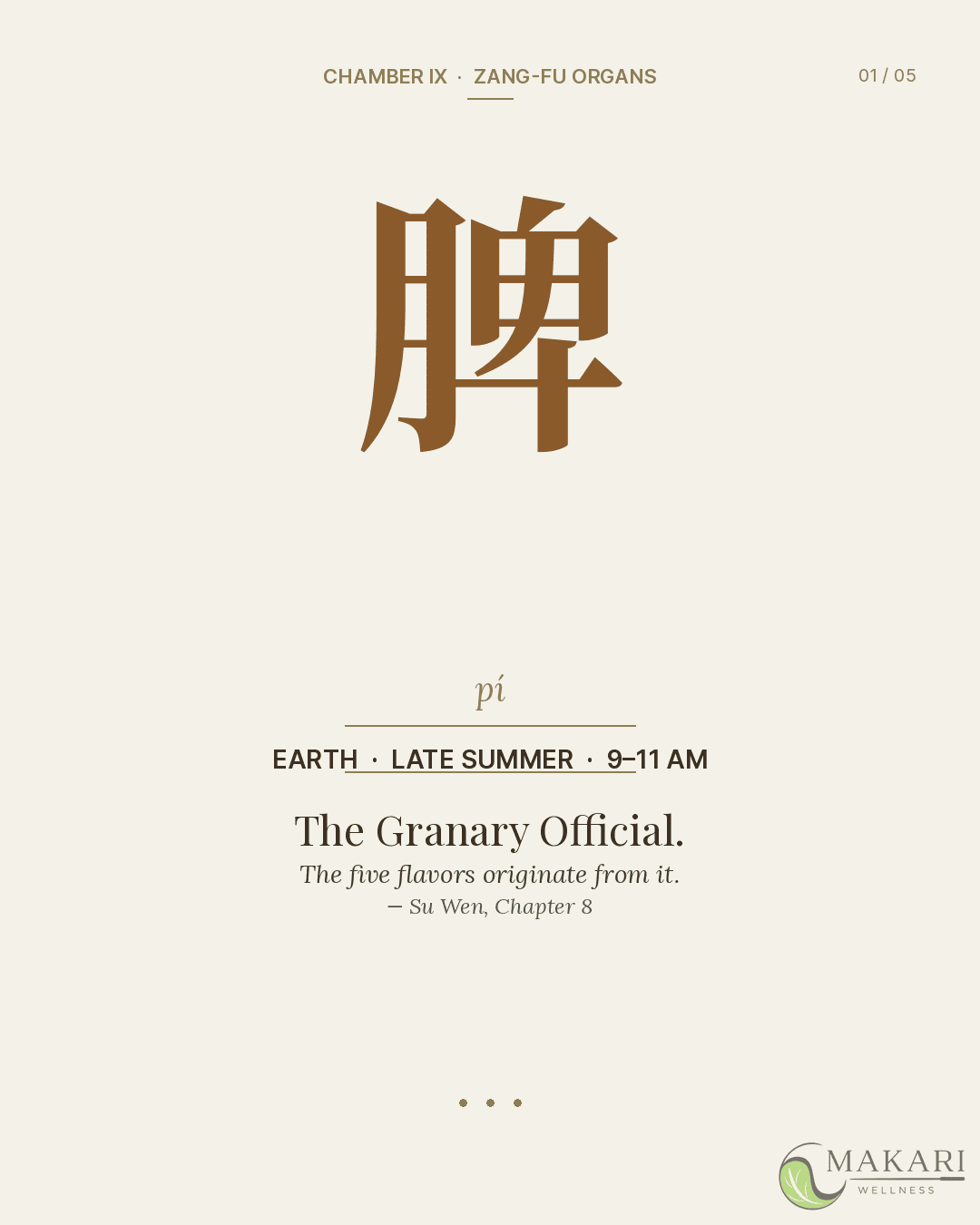
The Spleen and Stomach are the granary; the five flavors emerge from them.
— Su Wen, Chapter 8
The Spleen is the granary official — the central engine of digestion and transformation in classical medicine. Its primary function is to transform and transport: to extract the nutritive essence from food and drink, and to distribute that essence upward to the Lung and Heart, and outward to the four limbs. This is the foundation of post-heaven qi — everything the body generates and sustains after birth.
The Spleen is also the organ most vulnerable to the modern lifestyle: excess cold and raw foods dampen its transforming fire, irregular meals disrupt its rhythm, and overthinking and worry — the Spleen’s associated emotion — exhaust its qi before food even arrives. When the granary fails, the whole kingdom goes hungry: fatigue, weight irregularity, digestive dysfunction, foggy cognition, and accumulating dampness and phlegm are all downstream consequences of a struggling Spleen.
What the Spleen Governs
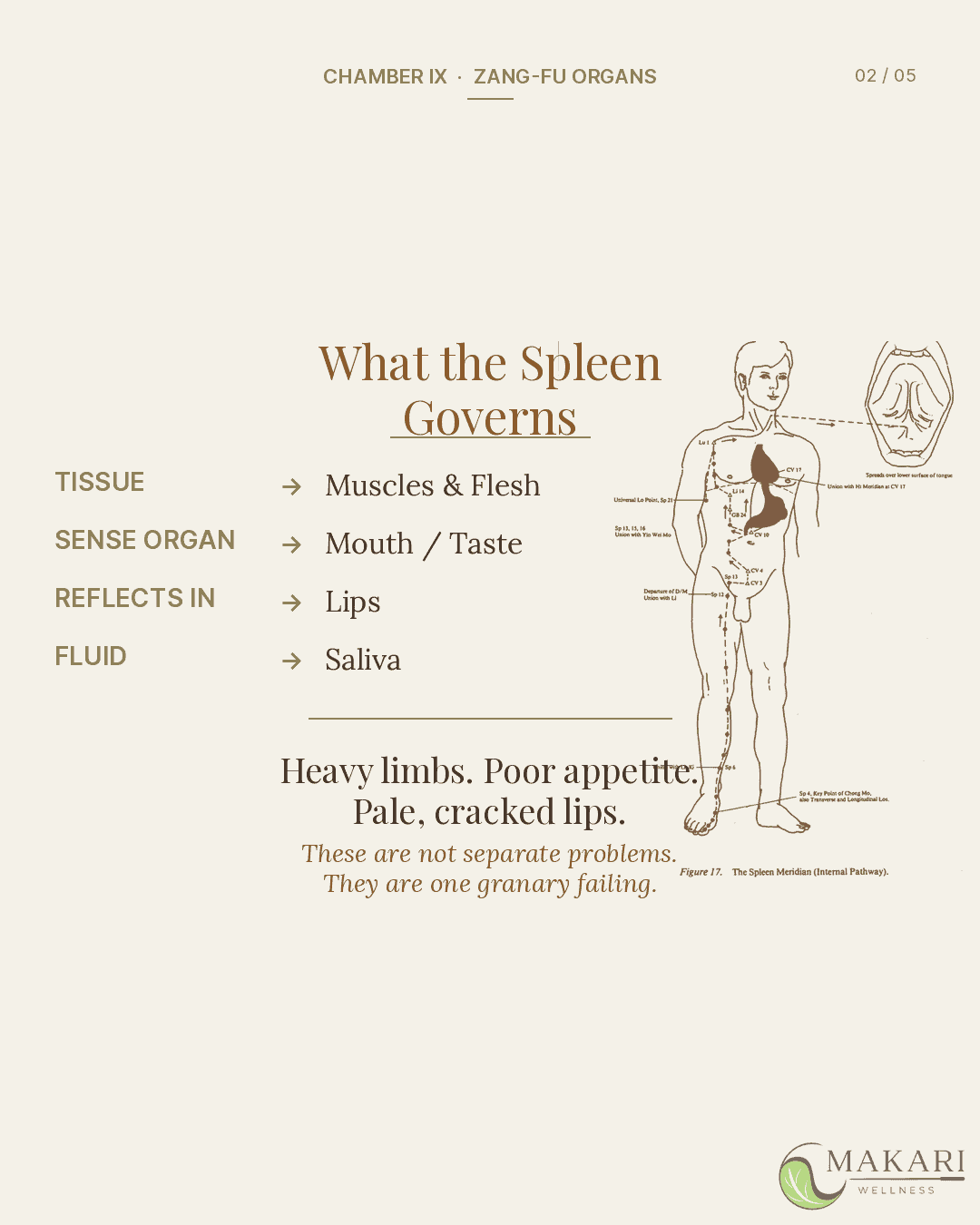
- Body Tissue → Flesh & the four limbs (muscle mass, weight maintenance, limb vitality)
- Sense Organ → Mouth (appetite, taste perception)
- Reflects In → Lips (pale or dry lips indicate Spleen depletion)
- Fluid → Saliva (excessive or deficient saliva are both Spleen signals)
- Paired Fu Organ → Stomach (the Stomach receives; the Spleen transforms and sends upward)
- Emotion → Worry & overthinking (circular thought that cannot resolve)
- Flavor → Sweet (moderate sweetness nourishes the Spleen; excess weakens it)
The Spirit: 意 Yì — Intention & Applied Thought
The Spleen stores the Yì — intention, the capacity to apply the mind to a task, to study, concentrate, and retain information. When the Spleen is strong, the mind is focused and learning is easy. When the Spleen is depleted — by chronic worry, a diet of cold and damp foods, overwork without nourishment, or simply insufficient rest — the Yì becomes muddy: difficulty concentrating, forgetfulness, the sense that thoughts are arriving through fog, and the kind of circular overthinking that exhausts rather than resolves. “The Spleen stores nourishment; nourishment is the dwelling of the Yì.” — Ling Shu, Chapter 8
What Patients with Spleen Imbalance Often Notice
- Fatigue after eating — a pronounced energy crash 30–60 minutes after meals, sometimes called ‘food coma’; the Spleen is using all available qi just to digest
- Bloating that begins during the meal and expands after — abdomen distended and uncomfortable for hours
- Craving for sweet foods (the flavor that the Spleen calls for when depleted) — but the craving worsens the condition
- Loose, unformed stools; possibly mucus in stool; or alternating loose and difficult stool
- Heavy, sluggish feeling in the limbs — ‘moving through mud’; physical heaviness without a specific musculoskeletal cause
- Easy bruising — the Spleen governs holding blood in the vessels; when qi is weak, blood leaks
- Poor appetite or a flat sense of taste — food doesn’t have much appeal or flavor
- Water retention or puffiness, especially in the lower limbs, ankles, or face in the morning
- Recurrent nausea, especially in the morning; sensitive stomach
- Foggy thinking, difficulty studying or retaining information, poor short-term memory
- Overthinking and circular worry — unable to stop running the same thoughts
- Dull headache, especially across the forehead or behind the eyes, with heaviness
- Phlegm: excess mucus in the throat, sinuses, or lungs — ‘the Spleen is the source of phlegm’
When the Spleen Fails
Spleen Qi Deficiency — The Empty, Tired Pattern:
- Fatigue, especially after eating or on exertion
- Loose or unformed stools; poor absorption (undigested food in stool)
- Poor appetite; reduced taste sensation; no desire to eat in the morning
- Abdominal bloating and fullness after meals
- Muscle weakness; poor stamina; limbs feel heavy and tired
- Pale or sallow complexion; pale lips
- Tendency to bruise easily
- Weak voice; desire to be still rather than active
Spleen Qi Deficiency is the foundational pattern — most other Spleen patterns develop from this root. It is extremely common and often underlies chronic fatigue, irritable bowel symptoms, and post-COVID fatigue syndromes.
Spleen Dampness or Yang Deficiency — The Heavy, Obstructed Pattern:
- Heavy, sluggish limbs and body — significant sense of physical heaviness
- Nausea; dull abdominal discomfort; desire to lie down
- Loose stools with mucus; urgency or incomplete evacuation
- Thick, sticky coating on the tongue (the hallmark damp tongue sign)
- Foggy head; poor concentration; sluggish mental processing
- Edema in the lower limbs or face
- Excess phlegm — mucus production in lungs, sinuses, or digestive tract
- In women: heavy vaginal discharge; in men: sense of heaviness in the genitals
When Spleen Qi Deficiency advances, Yang weakens and fails to transform fluids — dampness accumulates. In modern clinical practice, this often presents as weight gain unresponsive to diet change, chronic sinus congestion, brain fog, or metabolic syndrome patterns.
🔔 The Lung — Metal Phase
METAL · AUTUMN · 3–5 AM ORGAN CLOCK
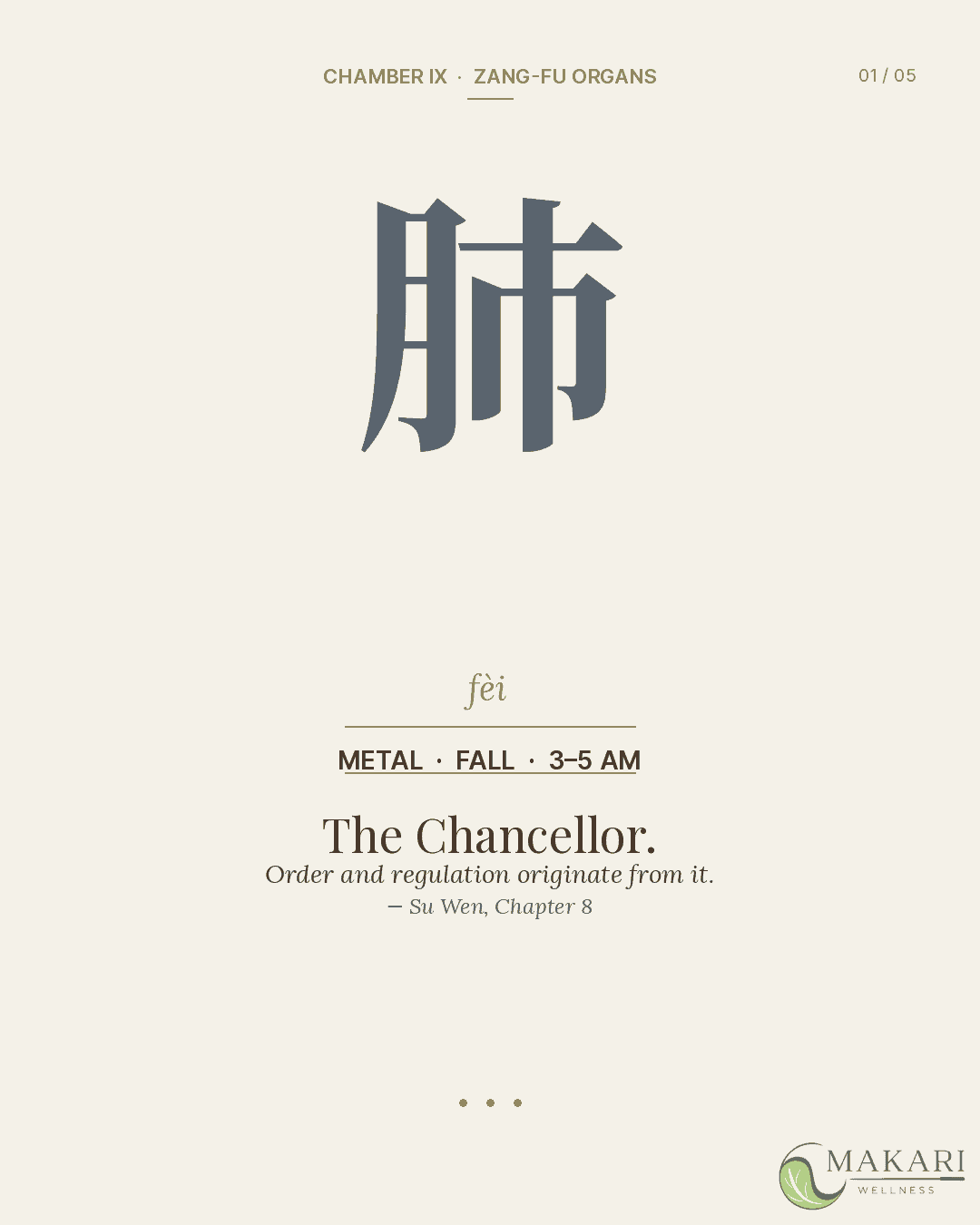
The Lung is the minister and chancellor; regulation and governance emerge from it.
— Su Wen, Chapter 8
The Lung is the minister of the body-state — the organ that receives the heavenly qi (air, breath, prana) and distributes it downward and outward to every cell and surface. The Lung governs two primary movements: descending and dispersing — sending qi downward to warm and nourish the organs below, and outward through the skin and pores to form the body’s protective boundary (Wei Qi, the defensive qi that guards against external pathogens).
The Lung is the organ most directly exposed to the external environment — its paired sense organ is the nose, its body tissue is the skin. Every pathogen that enters from outside (classical texts speak of Wind, Cold, Heat, Dryness, and Dampness as environmental factors) enters through the Lung’s domain. This makes the Lung the first line of defense — and the first organ to show signs when immunity is low.
What the Lung Governs

- Body Tissue → Skin & pores (the body’s outer boundary and barrier; perspiration regulation)
- Sense Organ → Nose (smell, the quality of breath)
- Reflects In → Body hair (luster and density of body hair reflect Lung health)
- Fluid → Nasal mucus (the Lung moistens the nose and upper airway)
- Paired Fu Organ → Large Intestine (the Lung descends; the Large Intestine lets go — both govern release)
- Emotion → Grief & sadness (in balance: appropriate mourning and release; in excess: unresolved grief that cannot move)
- Flavor → Pungent/Spicy
The Spirit: 魄 Pò — The Corporeal Soul
The Lung stores the Pò — the Corporeal Soul — the somatic, instinctive aspect of consciousness that grounds us in the body itself. The Pò governs automatic bodily rhythms: breathing, blinking, the startle reflex, the rhythmic movements of the gut. It is the faculty of the body’s deep intelligence — the non-cognitive wisdom that knows how to regulate without thinking. The Pò is also the faculty of letting go. Grief, loss, and the inability to release are the emotional expressions most directly tied to the Lung. When unresolved grief lodges in the chest — “grief affects the Lung” — the Pò cannot release. This shows up physically as constipation, skin congestion, and shallow breathing, and emotionally as the inability to grieve, to move on, or to finish and release creative work. “The Lung stores qi; qi is the dwelling of the Pò.” — Ling Shu, Chapter 8
What Patients with Lung Imbalance Often Notice
- Waking between 3–5 AM and being unable to return to sleep — the Lung’s organ clock window
- Getting sick frequently — every cold or flu that circulates seems to catch you; slow recovery from illness
- Skin conditions: eczema, psoriasis, rosacea, acne, excessive dryness, or poor wound healing
- Dry throat, dry cough (especially worse at night or in autumn), or a voice that fatigues easily
- Poor sense of smell; chronic nasal congestion or sinusitis
- Shallow breathing; a tendency to breathe into the chest rather than the abdomen
- Feeling flat, sad, or emotionally grey without a specific cause — especially in autumn as the Metal season begins
- Difficulty letting go — of relationships, possessions, old identities, grief, or creative projects
- Constipation (the Large Intestine, the Lung’s paired organ, governs release — when the Lung fails to descend, the bowel stagnates)
- Spontaneous sweating throughout the day; the pores cannot properly open and close
- Nostalgic or ruminative thinking — living in the past; difficulty moving forward
- Weak voice; talking at length is exhausting; shortness of breath on minimal exertion
- In children: recurrent respiratory infections, asthma, or sensitive skin (eczema) — often a sign of Lung Wei Qi deficiency
When the Lung Fails
Lung Qi Deficiency — The Weak, Unprotected Pattern:
- Shortness of breath, especially on exertion — easily winded
- Weak voice; speaking at length takes effort
- Spontaneous sweating (day sweats without exertion) — the pores lose their ability to close
- Frequent colds and respiratory infections; slow recovery
- Pale, dull complexion; pallor
- General fatigue; poor stamina; feeling ‘flat’
- Sensation of cold in the upper chest; aversion to wind and cold
Lung Qi Deficiency often follows prolonged illness, grief, or overwork. It is a common pattern in patients with asthma, post-viral syndromes, or chronic sinusitis. It also underlies susceptibility to environmental triggers — pollen, dust, cold air.
Lung Yin Deficiency — The Dry, Hot Pattern:
- Dry cough — often unproductive, or producing small amounts of sticky or blood-tinged sputum
- Dry throat and mouth, worse at night
- Afternoon or evening heat sensation; low-grade fever
- Night sweats
- Hoarse or thin voice
- Dry skin; possibly chronic eczema or psoriasis
- Restlessness; agitation in the evening
Lung Yin Deficiency is the more serious, depleted pattern — common in smokers, those in chronically dry environments, people who have been on long courses of antibiotics, or those who have had tuberculosis or severe respiratory illness. It also develops over time in Lung Qi Deficiency that has not been addressed.
One Kingdom. Five Officials. Your Whole Pattern.
Classical Chinese medicine does not ask: which organ is sick? It asks: which official is failing — and why is the whole body-state suffering as a result? This systemic, pattern-based lens is what distinguishes classical practice from symptomatic treatment, and it is the lens we bring to every patient at Makari Wellness.
The five Zàng organs do not operate in isolation. They nourish each other through the Sheng (generation) cycle: the Kidney (Water) nourishes the Liver (Wood), which feeds the Heart (Fire), which warms the Spleen (Earth), which consolidates and descends to the Lung (Metal), which returns essence downward to the Kidney. They also regulate each other through the Ko (control) cycle — each element keeping another in check, preventing any single official from overrunning the kingdom. A disruption in one official ripples through the whole system. A well-targeted treatment restores not just the organ, but the relationships between all five.
You may have read through these five descriptions and recognized patterns in yourself — perhaps scattered across more than one organ. This is typical. After years of untreated stress, illness, dietary imbalance, or simply the accumulated demands of modern life, most patients present with multi-organ patterns. What classical medicine offers is not a symptom-by-symptom checklist, but a diagnosis of the whole — a unified understanding of why all these seemingly unrelated symptoms exist in the same body at the same time.
Real medicine has roots. The roots run five officials deep.
— Makari Wellness
If you recognize your own pattern in these descriptions — or if you have been moving from specialist to specialist without a unifying diagnosis — we invite you to come in for a classical assessment at Makari Wellness. We take the whole picture into account: your full history, your constitution, your current presentation, and the season of life you are in.
Book a Classical Diagnosis Assessment →
All classical quotations sourced from the Huang Di Nei Jing (Su Wen and Ling Shu). Image series: Chamber IX — The Zang-Fu Officials. Makari Wellness · makariwellness.com